
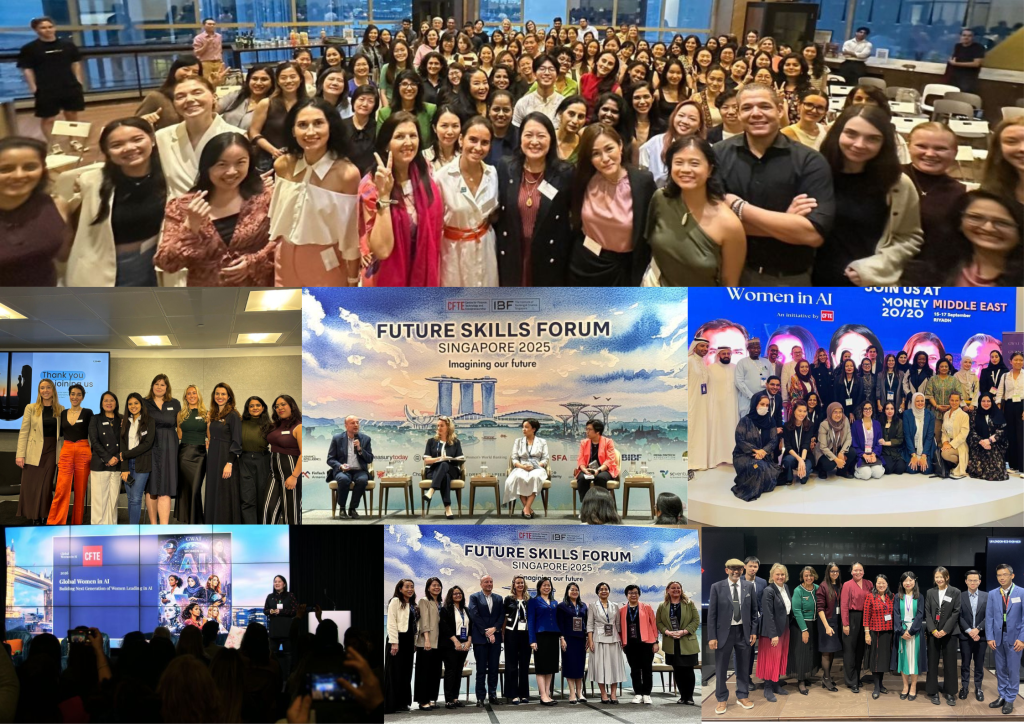
By Tram Anh Nguyen, Chairwomen of Global Women in AI
The global AI conversation has changed.
Over the past few weeks, I have moved across three major hubs: Abu Dhabi, Singapore, and London, and despite their different cultures, economies, and policy environments, I heard the same tension everywhere: excitement about what AI can unlock, and deep concern about who gets to participate in that future.
pite their different cultures, economies, and policy environments, I heard the same tension everywhere: excitement about what AI can unlock, and deep concern about who gets to participate in that future.
At a recent Global Women in AI gathering in Singapore, I raised a question that goes far beyond diversity statistics.
Today, only 10 women are among the 100 most influential people in AI.
Only one woman sits in the global top 10.
This isn’t a question of capability. It’s a question of participation.
This is the defining paradox of the AI era. The technology promises productivity, innovation, and entirely new business models. But it is also accelerating faster than institutions, labour markets, and talent systems can adapt. And when that happens, opportunity does not distribute itself evenly.
That is why one reality is becoming impossible to ignore: we are in an AI race for talent, and women remain underrepresented in the places where AI is being built, deployed, and led.
This is often framed as a diversity issue. It is. But it is also something else: a competitiveness issue.
At a time when businesses and governments are scrambling to find people who can turn AI into practical outcomes, leaving women behind is not just unfair. It is economically irrational.
The world does not have an AI technology problem alone. It has an AI translation problem. The shortage is not only in technical builders, but in people who can connect AI to operations, regulation, customer experience, risk, compliance, education, healthcare, and public services. In other words, the market needs domain-first professionals who can become AI-fluent and apply the technology where it matters most.
Women are already highly represented across many of these sectors. Yet too often, they are still excluded from the pathways that convert domain expertise into AI leadership.
That is the real risk of this moment.
The most dangerous outcome of AI acceleration is not simply job displacement. It is the widening of an AI opportunity gap between those who gain access to the skills, projects, networks, and sponsorship that make AI careers possible, and those who do not.
And that gap is being built right now.
Across markets, I see the same structural barriers repeating themselves.
First, the definition of AI talent remains far too narrow. Many organisations still behave as if AI talent means engineers only. But the future of AI will be shaped just as much by people who can implement, govern, adapt, and scale these systems in the real world.
Second, too many learning pathways stop at content. Women are enrolling in courses, earning certificates, and building knowledge but knowledge alone does not create career mobility. In today’s market, what matters is proof: projects, portfolios, deployment experience, and visible outcomes.
Third, hiring systems still reward pedigree over potential. Employers talk about AI talent shortages while filtering out career pivoters and nontraditional candidates who may be exactly the people capable of driving adoption.
Fourth, there is still a profound sponsorship gap. Mentorship helps. Sponsorship changes trajectories. Careers move when talented women are given access to high-impact opportunities, leadership visibility, and decision-making spaces.
And finally, there is the issue we discuss too little: visibility. When women do not see women leading in AI, many internalise the belief that this space is not meant for them.
That absence becomes self-reinforcing.
This is why inclusive AI leadership will not happen by accident. It requires infrastructure.
That is also why the cities I visited matter.
Conversations From Three Cities: Abu Dubai, Singapore, London
In Abu Dhabi, there is a clear understanding that talent strategy, inclusion, and national competitiveness must be designed together from the outset. When inclusion is built into procurement, public-sector deployment, and national talent pathways early, it becomes part of the system rather than a corrective added too late.
In Singapore, what stood out was the bias toward execution. Less rhetoric, more implementation. AI is being applied in finance, operations, compliance, risk, and public services which makes representation in decision-making even more important. Because once AI becomes embedded in real systems, the people around the table matter enormously.
In London, the energy around ecosystem-building remains strong, but one lesson is increasingly clear across all three cities: progress accelerates when communities are designed to last beyond individual events. Networks, visibility, and pathways are not “nice to have.” They are part of the talent infrastructure itself.
This is where entrepreneurship becomes especially important.
If women are to shape AI rather than simply adapt to it, they must be empowered not only as employees, but also as founders, builders, and system designers. AI is not just a tool adoption story. It is a product, service, and business model story. And in that world, women’s ability to connect technology to human needs, institutional realities, and trust becomes a strategic advantage.
But entrepreneurship does not emerge from encouragement alone. It requires confidence, capability, networks, distribution, sponsorship, and access to capital. Without ecosystem density, women build in isolation and isolation kills momentum.
At Global Women in AI, we see this challenge for what it is: not a motivational problem, but an infrastructure problem.
Supercharged 10,000 Women in AI
That is why we are launching the 10,000 Supercharged Women in AI course: a global initiative designed to help 10,000 women to learn AI Literacy, and then to become practically equipped to build with AI, gain confidence through application, and access an international network of peers, mentors, and leaders.
The goal is not simply to help more women learn about AI. It is to help more women move from interest to capability, from capability to projects, and from projects to leadership.
Because this is the real question of the AI era: who gets to shape the future, not just live with its consequences?
If governments, corporates, investors, and institutions are serious about building competitive and responsible AI economies, then backing women into AI leadership is not philanthropy. It is strategy.
We cannot afford to waste half of society’s talent at the most consequential technological turning point of our time.
