
Singapore’s approach to AI is compelling because it treats AI not simply as a technology agenda, but as a workforce and inclusion agenda. Its ambition to develop 100,000 “AI Bilingual” workers shows what it can look like when technology adoption, professional skills, job transformation and lifelong learning move forward together.
There is something particularly impressive about witnessing Singapore’s approach to artificial intelligence.
The conversation is not only about building better models, attracting AI companies or accelerating technology adoption. It is increasingly about a much bigger question:
How do you prepare an entire workforce for a world in which AI changes the nature of work?
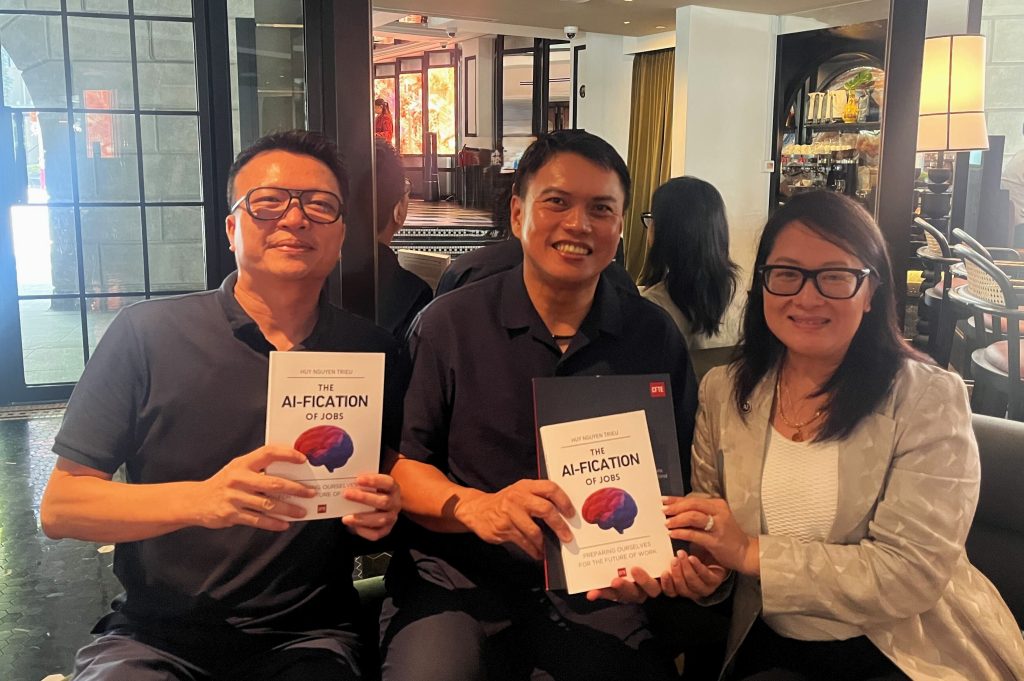
Our co-founder, Tram Anh Nguyen, recently had the opportunity to exchange perspectives with Joe Loy, Assistant Chief Executive and Managing Director, Digital Business & Corporate Solutions at NTUC LearningHub, and Patrick Tay, NTUC Assistant Secretary-General. The conversations explored the future of skills in an AI-powered world and, importantly, what it will take to make sure people are able to participate in that future rather than being left behind by it.
That distinction matters.
From AI adoption to AI bilingualism
Singapore is working towards supporting 100,000 workers to become “AI Bilingual” by 2029.
The idea behind AI bilingualism is powerful because it does not assume that everyone needs to become an AI engineer.
Instead, it combines two forms of expertise: a person’s knowledge of their own profession and the practical ability to understand and apply AI within that profession.
A lawyer remains a legal professional, but understands how AI can transform legal research and workflows.
An accountant retains deep financial and professional judgement, while learning where AI can improve analysis and productivity.
An HR professional understands people, organisations and talent, while becoming capable of applying AI responsibly to parts of their work.
Singapore’s National AI Impact Programme is beginning this effort with professions including accountancy and law, with plans to extend into areas such as HR. The TechSkills Accelerator programme is being expanded to help workers develop the practical AI capabilities needed to transform domain-specific workflows.
This changes the question from:
“How many people know how to use AI?”
to:
“How many people can combine AI with their professional expertise to do their work differently and better?”
That is a much more meaningful measure of workforce readiness.
Building the capability journey
A useful way to think about this transformation is as a progression:
AI awareness → AI literacy → AI fluency → AI application → AI specialisation
Awareness means understanding that AI is changing your industry.
Literacy means understanding what AI can and cannot do.
Fluency means being confident enough to work with AI within your profession.
Application means integrating AI into real workflows and using it to improve how work gets done.
Specialisation means developing deeper capabilities where the profession or role demands them.
The important point is that people do not need to jump immediately from having little experience with AI to becoming technical specialists.
There needs to be a pathway.
And there needs to be an infrastructure around that pathway that includes employers, education providers, government, professional bodies and workers themselves.
AI transformation is also job transformation
This is what makes the Singapore model particularly interesting.
It is not simply about teaching workers how to use the latest AI tool.
The broader challenge is about upskilling and reskilling at scale, redesigning jobs, helping enterprises transform workflows and giving workers the confidence to participate in an AI-enabled economy.
Singapore’s approach recognises that technology adoption and workforce transformation cannot happen independently.
If companies adopt AI without developing their people, the capability gap widens.
If people receive AI training but their jobs and organisational processes remain unchanged, much of that capability may never translate into meaningful impact.
And if access to AI skills is concentrated among a relatively small group of specialists, the economic benefits of the technology risk becoming concentrated too.
Singapore’s National AI Impact Programme therefore brings together both sides of the equation: it aims to support 100,000 workers in becoming AI Bilingual while helping 10,000 enterprises integrate AI into their business processes.
That connection between people and enterprises is critical.
AI should augment human potential
There is also an important principle behind this approach:
AI should augment human potential, not simply replace human potential.
This does not mean pretending that AI will not change jobs.
It will.
Tasks will change. Workflows will change. Some responsibilities will disappear while new ones emerge. The skills associated with many professions will evolve.
The question is whether workers have the opportunity to evolve alongside them.
Singapore’s current policy discussions explicitly recognise this challenge. Its tripartite partners have emphasised the need for job redesign and workforce reskilling as AI adoption accelerates, alongside practical support to help workers develop AI fluency.
This is where the conversation about lifelong learning becomes particularly important.
The importance of institutions such as NTUC LearningHub
A national AI strategy ultimately has to translate from policy into people’s everyday working lives.
That requires institutions capable of turning large ambitions into practical learning opportunities.
NTUC LearningHub’s current AI-Ready SG approach focuses on building practical AI skills for work, moving from AI literacy towards applied capability. It sits within a much broader lifelong learning ecosystem designed to help individuals continually develop skills as their careers and industries evolve.
Our exchanges with Joe Loy and Patrick Tay reinforced how important this layer of the ecosystem is.
Because the AI transition will not happen through technology policy alone.
It will happen when an accountant changes the way they analyse information.
When an HR professional redesigns a workflow.
When a manager becomes confident enough to identify where AI can create value.
When an SME can adopt AI without needing to build an AI research team.
And when workers at different stages of their careers know there is a pathway for them to continue learning.
The real test of a national AI strategy
The success of an AI strategy will naturally be measured through investment, adoption, innovation and productivity.
But there should be another measure too.
Can people participate?
Are workers equipped to adapt?
Can professionals combine their existing expertise with new AI capabilities?
Can SMEs access the skills required to transform?
Can people whose jobs are changing find credible pathways towards new opportunities?
And is the next generation entering the workforce prepared not simply to use AI, but to exercise judgement alongside it?
These questions move AI from being purely a technology conversation to becoming a question of economic participation.
That may ultimately be one of the most important aspects of Singapore’s approach.
The country has an opportunity to demonstrate what a genuinely inclusive national AI strategy can look like: one where technology, skills, enterprises, workers and opportunity move forward together.
It was impressive to witness these ideas being translated into action and to exchange perspectives with NTUC and NTUC LearningHub on what the future of skills could look like.
At CFTE, we look forward to continuing these conversations and advancing the work around building the capabilities people and organisations will need in an AI-powered world.
