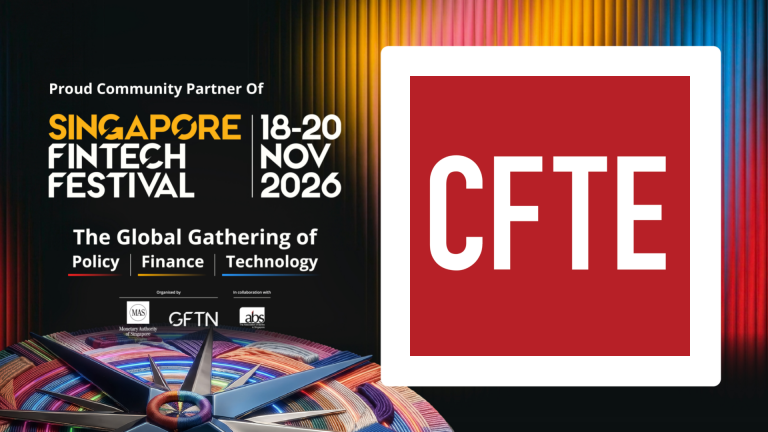
The Singapore FinTech Festival 2026 (SFF 2026) takes place from 18 to 20 November at Singapore EXPO, with more than 70,000 participants expected from 142 countries and regions (CFTE SFF 2026 page). Its theme, “The Coming Rewiring of the Financial System: New Risks. New Rules. New Growth.”, is built around five forces: technology, geoeconomics, capital, talent and policy (MAS media release).
CFTE is an official Community Partner of SFF 2026, and co-founder Tram Anh Nguyen is an SFF 2026 Ambassador for Talent Rewiring. Based on CFTE’s programme around festival week, these are five questions on AI and talent worth following, and where they will be discussed.
1. Can financial institutions build AI capability at scale, not just run courses?
Financial centres have moved from individual training to workforce-wide commitments. In Singapore, 23 financial institutions in the IBF AI Workforce Co-Lab have committed to train more than 80,000 employees in AI by 2028 (The Edge Singapore). In the UK, 22 firms have signed the Financial Services Skills Compact to upskill their entire UK workforces over a rolling three years (GOV.UK).
The question to watch is quality rather than scale: whether training translates into people who can redesign work, govern risk and judge AI output. This is the heart of the festival’s Talent Rewiring track.
2. Is AI pulling the career ladder up for graduates?
Early evidence suggests entry-level roles are most exposed. Stanford researchers found a 13 percent relative decline in employment since late 2022 for workers aged 22 to 25 in the most AI-exposed occupations in the United States (Stanford paper).
Where to follow it: the GFTN roundtable “Is AI Pulling the Ladder Up? Reimagining Job-Ready Skills in the AI Transition” at the Insights2040 Annual Meetings on 17 November, with Tram Anh Nguyen and leaders from IBF, the Asian Development Bank, the World Economic Forum, MUFG Bank, Google and data.org (CFTE event page; invitation only, apply to attend Insights2040).
3. How can the industry share evidence on real AI use?
Most institutions can say they use AI; far fewer can show where it is applied and what evidence supports it. The AI Spotlight Observatory, developed in the context of the UK FCA AI Lab in collaboration with CFTE, combines a practical taxonomy with documented AI implementations so that use cases can be described and compared consistently.
Where to follow it: the Observatory’s Singapore launch on 19 November, 17:00 to 20:00 SGT, for regulators, central banks, financial institutions and experts (event page; invitation only, request an invitation).
4. What do SMEs need to adopt AI and grow?
Small firms are behind on AI: across OECD countries, 11.9 percent of small firms use it compared with 40 percent of large firms (OECD). The barriers are often skills and management capacity as much as access to finance.
Where to follow it: two Global SME Finance Forum sessions with Tram Anh Nguyen: the panel What Makes SMEs Grow? Skills, Services and Technology Adoption on 19 November, and the training Build Your Small Business Growth Enablement Action Plan on 20 November, with Silver Lining and the World Bank Group.
5. How will emerging markets design their own financial rails?
Just before SFF, Black Swan Summit Cambodia, hosted by the National Bank of Cambodia and GFTN on 15 and 16 November, asks how emerging markets can build and govern infrastructure suited to their needs. Cambodia’s Bakong system processed US$241.84 billion in 2025, around six times GDP, according to the organisers.
Where to follow it: four sessions with Tram Anh Nguyen and Huy Nguyen Trieu, on informal economies, sandbox-to-scale innovation, shared payment rails and the future of emerging-market finance (CFTE at Black Swan Summit Cambodia).
Why these questions matter together
The five questions share a common thread: the outcome of AI in finance will depend on people as much as on technology. Whether the subject is a bank’s workforce, a graduate’s first job, a regulator’s evidence base, a small business or a national payment system, the deciding factor is the capability to use new tools responsibly. That is the lens CFTE brings to SFF 2026.
Meet CFTE during SFF week
CFTE co-founders Huy Nguyen Trieu and Tram Anh Nguyen will be in Singapore throughout SFF week, and the CFTE team will be at its booth in the UK Pavilion on 20 November.
- Register for SFF 2026: use CFTE’s partner code CP-DISC-20-CFTE for 20% off delegate passes (register).
- Attend the Global SME Finance Forum: use the discounted industry registration link.
- Meet the team: request a meeting through the CFTE SFF 2026 page.
Festival registration does not include access to invitation-only side events. The full programme is on the official Singapore FinTech Festival website.
Frequently asked questions
When is the Singapore FinTech Festival 2026?
SFF 2026 takes place from 18 to 20 November 2026 at Singapore EXPO, organised by the Monetary Authority of Singapore and GFTN.
What are the key themes of SFF 2026?
Five forces under “The Coming Rewiring of the Financial System”: Technology Rewiring, Geoeconomic Rewiring, Capital Rewiring, Talent Rewiring and Policy Rewiring.
Which CFTE sessions are open to attend?
The Global SME Finance Forum sessions are open to Forum participants. The Insights2040 roundtable and the AI Spotlight Observatory launch are invitation only; you can apply or request an invitation through the links above.
About CFTE
The Centre for Finance, Technology and Entrepreneurship (CFTE) is a global platform that partners with financial institutions, regulators and governments to build future-ready workforces at scale. Founded in 2017 by Huy Nguyen Trieu and Tram Anh Nguyen, CFTE has supported more than 200,000 professionals across 130+ countries and works with 250+ leading organisations. It has offices in London, Singapore and Abu Dhabi.
CFTE’s work spans AI capability diagnostics, role-based learning pathways and executive education, built on public frameworks including the CFTE AI Proficiency Framework, the Performance Hexagon and SHIME. CFTE founded Global Women in AI to help more women lead, build and shape the future of AI. Learn more at cfte.education.