
H.E. Dr. Serey Chea, Governor of the National Bank of Cambodia, opened Black Swan Summit Cambodia on 15 November 2026 with a simple test for any financial system: who does it reach? Her answer set the tone for a day on trust, inclusion and the shared infrastructure behind Cambodia’s digital payments.
The Black Swan Summit is a global series of summits run by the Global Finance & Technology Network (GFTN), a not for profit organisation set up by the Monetary Authority of Singapore in 2024. It explores how innovation and disruption can build more resilient economies and more inclusive societies. Its name comes from the idea of “black swan” events: rare, unpredictable shocks with a large impact.
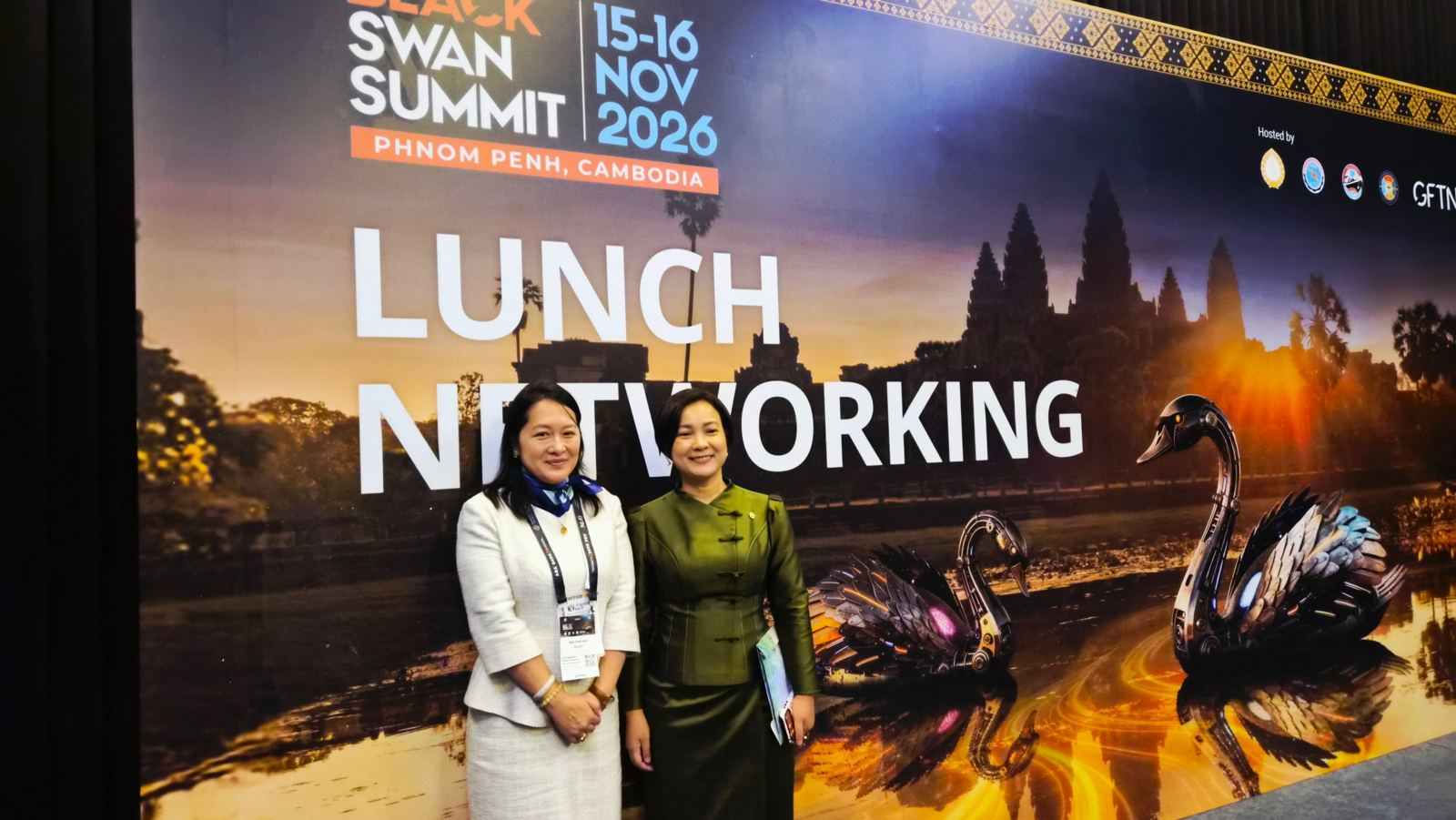
This was the first time Cambodia hosted the summit. Held on 15 and 16 November 2026 at the Diamond Island Convention and Exhibition Center in Phnom Penh, under the theme “Disruptive by Design”, it was hosted by the National Bank of Cambodia and GFTN, in collaboration with the Association of Banks in Cambodia and the Cambodian Association of Finance and Technology (CAFT).
Huy Nguyen Trieu and Tram Anh Nguyen, co-founders of the Centre for Finance, Technology and Entrepreneurship (CFTE), joined central bankers, regulators and industry leaders in Phnom Penh. CFTE helps financial institutions, regulators and governments build the skills their people need for AI and digital finance. On the same day, Tram Anh also spoke at FrancoTech, a fintech event held alongside the Francophonie summit.
From no money to national scale
In her opening address, the Governor recalled the period after 1975, under the Khmer Rouge, when money was abolished, banks disappeared and the central bank itself was destroyed. Within a few decades, Cambodia rebuilt its financial system from zero.
Today, Bakong sits at the centre of that system. Bakong is Cambodia’s national payment system. The National Bank of Cambodia launched it in October 2020, built with Japanese technology company SORAMITSU. It connects banks, microfinance institutions and payment providers, so people can send money and pay by QR code in real time, in US dollars or Khmer riel. It processed about 1.33 billion transactions in 2025. The Governor knows it well: she was the central bank’s Director General when Bakong launched in 2020.
That rebuild from zero is the black swan at the heart of the summit. It is also a practical case study for any country asking how a financial system earns trust.
Who is still left out
“A financial system should be judged by who it reaches, not by how much money it moves.”
H.E. Dr. Serey Chea, Governor, National Bank of Cambodia
The Governor described how trust makes financial innovation useful. Credit records help lenders recognise borrowers beyond their collateral. Shared infrastructure through Bakong connects financial institutions with the people they serve.
She was also clear about the work ahead. Women, rural households and people in informal work remain less included. Cambodia’s 2026 to 2030 inclusion strategy puts women at its centre. It measures progress by whether a family can withstand a financial shock without sacrificing its future, not only by whether it has an account.
Building for local needs
Sopnendu Mohanty, Group CEO of GFTN, explained that Cambodia chose its own path when existing payment solutions proved too expensive. It built an interoperable system using blockchain technology. Other countries designing infrastructure around their own needs can learn from that choice.
What this means for other emerging markets
- Start from local constraints. Cambodia built what it needed when existing options were too costly.
- Measure resilience, not just reach. The real test is whether households and small businesses can absorb a shock.
- Plan for people early. Supervisors, bank teams and merchants all need the skills to run, govern and use shared infrastructure.
For CFTE, this is why workforce transformation at scale belongs alongside investment in technology. As payment systems connect and AI changes financial services, building these capabilities is part of building the infrastructure itself.
CFTE thanks the National Bank of Cambodia, GFTN, the Association of Banks in Cambodia and CAFT for bringing this community together. See all of CFTE’s sessions on the CFTE at Black Swan Summit Cambodia 2026 page.
Continue the conversation in Singapore
Huy Nguyen Trieu, Tram Anh Nguyen and the CFTE team will be at Singapore FinTech Festival from 18 to 20 November 2026.
- Meet the team: visit the CFTE booth at the UK Pavilion, Singapore EXPO, on 20 November.
- See the full schedule: CFTE at SFF 2026
- Build AI capability in your team: explore the CFTE AI Proficiency Framework
Further reading
- CFTE Discusses the Future of Finance at Black Swan Summit and FrancoTech
- CFTE Introduces Senior Leadership Alignment Programme for Financial Institutions and Central Banks
- What Do Payments Professionals Need to Know About Agentic Payments?
About CFTE
The Centre for Finance, Technology and Entrepreneurship (CFTE) is a global education company with a presence in London, Singapore and Abu Dhabi, dedicated to workforce transformation at scale.
Founded in 2017, CFTE believes that technological progress should create opportunities for everyone. As artificial intelligence and emerging technologies reshape industries and economies, CFTE works with governments, central banks, regulators and leading financial institutions to equip individuals, organisations and leaders with the capabilities to thrive in a changing world.
By bringing together leading industry practitioners, academic expertise and innovative learning approaches, CFTE bridges the gap between technological change and real-world application, enabling transformation from individual professionals to entire workforces.
CFTE has reached more than 200,000 participants across 130 countries.