
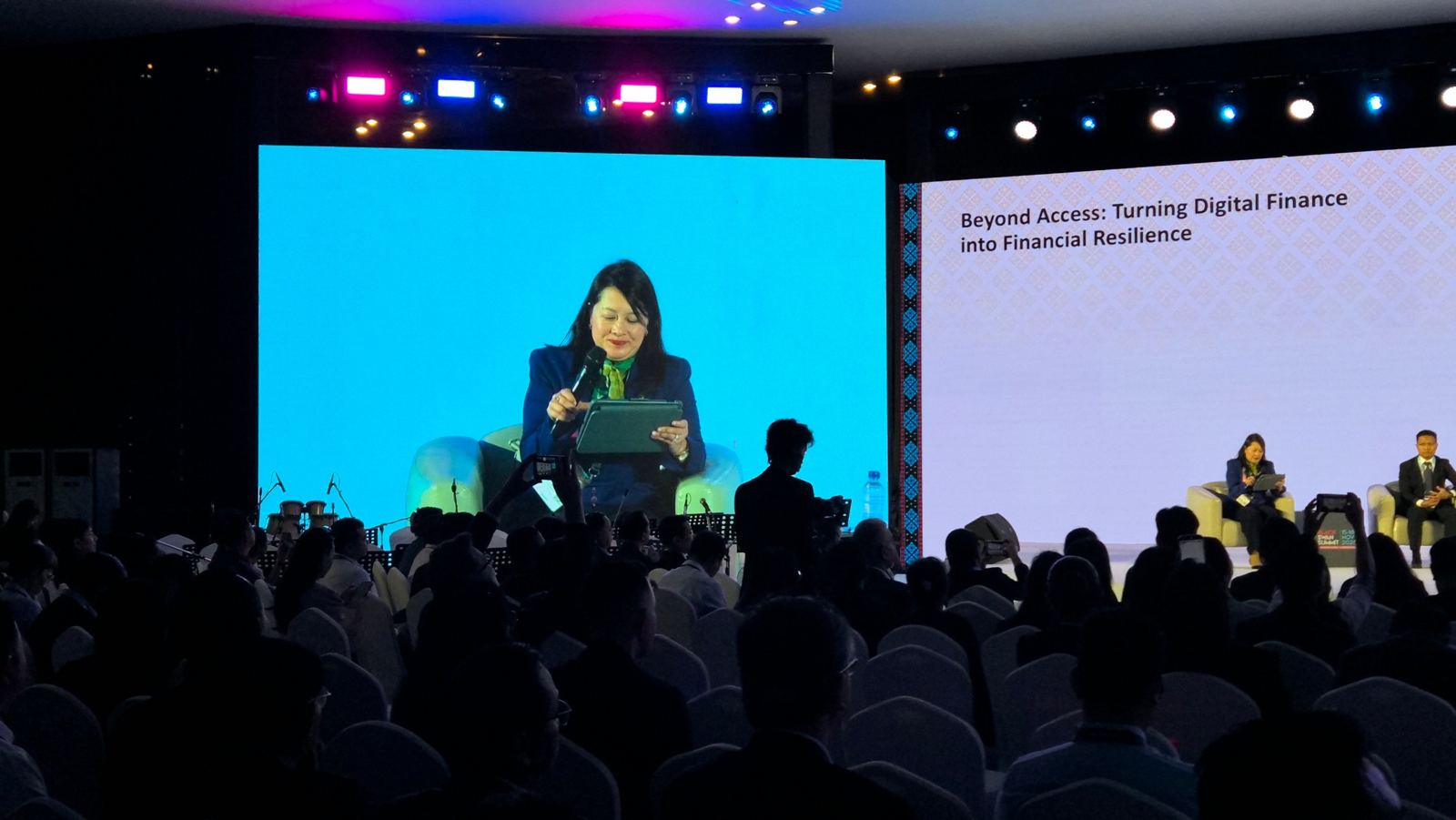
A successful pilot proves that a product works. It does not prove that regulators, banks, customers or other markets will accept it. That gap was the focus of the panel CFTE co-founder Tram Anh Nguyen moderated at Black Swan Summit Cambodia on 16 November 2026.
The panel was titled “Beyond Access: Turning Digital Finance into Financial Resilience”. Getting people onto digital payments is only the first step. For digital finance to make people and businesses more resilient, new ideas have to move from testing to services that people can rely on every day.
The panel brought together a central bank, a technology provider and two founders: Ouk Sarat, Deputy Director General of Central Banking Operations at the National Bank of Cambodia; Makoto Takemiya, CEO of SORAMITSU, the Japanese technology company that built Cambodia’s Bakong payment system with the central bank; Rithy Thul, Founder and CEO of smallworld; and Eddie Lee, Co-Founder and CEO of Pilon.
What should a successful test earn an innovator?
Most conversations about financial innovation focus on the beginning: the pilot, the proof of concept, the sandbox. Fewer look at what happens when testing ends. That is where many promising innovations stall.
A regulator still has to approve the product. A bank still has to integrate it. Customers still have to adopt it, and another market still has to recognise it. Each is a separate hurdle.
Lessons from Bakong
Bakong is Cambodia’s national payment system. The National Bank of Cambodia launched it in October 2020, built with Japanese technology company SORAMITSU. It connects banks, microfinance institutions and payment providers, so people can send money and pay by QR code in real time, in US dollars or Khmer riel. It processed about 1.33 billion transactions in 2025, and has moved from concept to an essential part of Cambodia’s financial infrastructure.
The panel looked at how that happened, and how more local innovators could now build on the same rails.
Why promising innovations struggle to scale
Most innovators do not have a central bank behind them. Across Southeast Asia, funding has tightened, investors want a clear path to profit, and financial institutions are more selective about what they adopt. Proving the technology works is no longer enough. Firms must show that someone needs it, will pay for it and can sustain it.
At the same time, AI is making software cheaper and faster to build. That could open innovation to many more entrepreneurs, and test whether regulators and institutions are ready for them.
Can innovation travel across borders?
Cambodia already links its payments with neighbouring markets through cross border QR payments. The regulatory journey is less connected. A firm that has succeeded in one market may still need to start much of the process again in the next.
The panel asked whether evidence of a credible test could travel as easily as payments now do, and what regulators would need to see from each other to make that possible.
What this means for innovators and regulators
- Design tests for the next audience. Collect the evidence regulators, banks and investors will ask for, not only proof that the product works.
- Answer “who pays?” early. Plan how the system will be funded and run once the pilot ends.
- Build the capability to judge new ideas. Regulators and institutions need people who can evaluate innovations they have not seen before.
For CFTE, the lesson is clear. A successful test is not the end of the journey. It is the start of the next challenge. The real measure is whether an innovation creates lasting value at scale.
More from day two
CFTE co-founder Huy Nguyen Trieu was also in Phnom Penh for the summit. Later sessions on day two included the closing panel “A Different Financial Future: What Emerging Markets Can Shape, Share and Scale” and the roundtable “Who Owns the Rails? Governance, Access and the Economics of Shared Infrastructure”.
CFTE thanks the panellists, the National Bank of Cambodia, GFTN, the Association of Banks in Cambodia and CAFT for two days of open and practical discussion. See all of CFTE’s sessions on the CFTE at Black Swan Summit Cambodia 2026 page.
Continue the conversation in Singapore
Huy Nguyen Trieu, Tram Anh Nguyen and the CFTE team will be at Singapore FinTech Festival from 18 to 20 November 2026.
- Meet the team: visit the CFTE booth at the UK Pavilion, Singapore EXPO, on 20 November.
- See the full schedule: CFTE at SFF 2026
- Build AI capability in your team: explore the CFTE AI Proficiency Framework
Further reading
- CFTE Discusses the Future of Finance at Black Swan Summit and FrancoTech
- From AI Experimentation to AI as Usual: What It Takes to Scale AI in Banking
- From AI Pilots to Responsible Adoption: What Financial Services Needs Next
- What We Learned from Regulators at the Arab Monetary Fund’s Fintech Working Group
About CFTE
The Centre for Finance, Technology and Entrepreneurship (CFTE) is a global education company with a presence in London, Singapore and Abu Dhabi, dedicated to workforce transformation at scale.
Founded in 2017, CFTE believes that technological progress should create opportunities for everyone. As artificial intelligence and emerging technologies reshape industries and economies, CFTE works with governments, central banks, regulators and leading financial institutions to equip individuals, organisations and leaders with the capabilities to thrive in a changing world.
By bringing together leading industry practitioners, academic expertise and innovative learning approaches, CFTE bridges the gap between technological change and real-world application, enabling transformation from individual professionals to entire workforces.
CFTE has reached more than 200,000 participants across 130 countries.