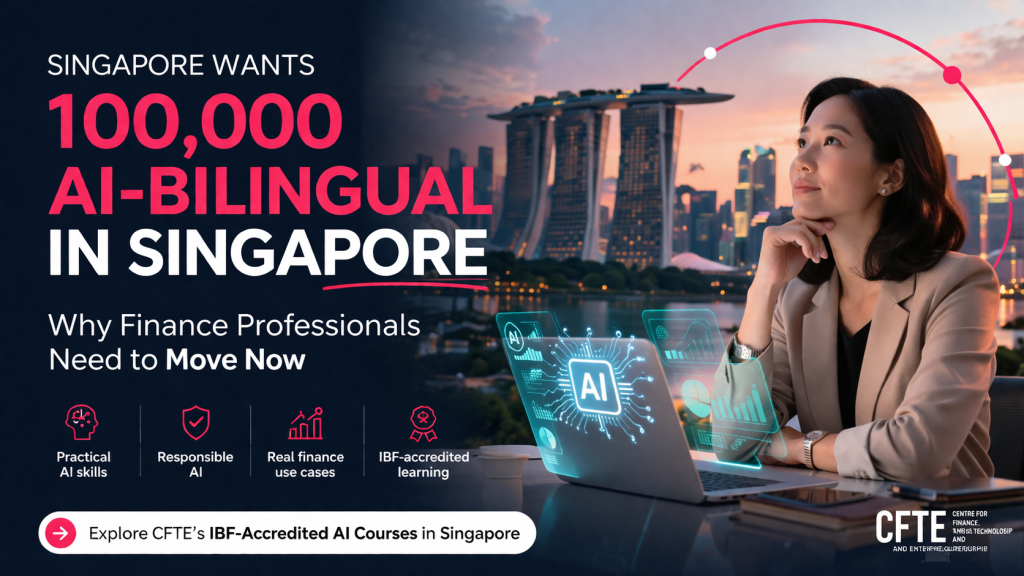
Singapore is pushing to build an AI-bilingual workforce, aiming to train 100,000 workers by 2029.
For finance professionals, that is not just a headline.
It is a warning shot.
Singapore has made its direction clear.
That number should make every finance professional pause.
Because this is not simply a national skills initiative. It is a signal.
A signal that AI is no longer sitting on the edge of business strategy. It is moving into the centre of how work gets done, how decisions are made, and how value is created.
According to a recent report by The Straits Times, Singapore is accelerating efforts to build an AI-ready workforce at scale.
And in financial services, where precision, trust, regulation and speed all matter, the implications are even bigger.
The new expectation: becoming AI-bilingual
“AI-bilingual” is quickly becoming one of the most important ideas in workforce transformation.
But let’s be clear about what it does not mean.
It does not mean every professional needs to become a machine learning engineer.
It does not mean everyone should suddenly start coding models or building agents from scratch.
What it does mean is this: professionals need to be fluent enough in AI to understand what it can do, where it creates value, where the risks are, and how to apply it responsibly in their own domain.
In other words, they need to speak two languages at once: the language of their profession, and the language of AI.
That is what being AI-bilingual really means.
Why finance professionals in Singapore should pay attention now
Financial services is one of the sectors where AI will not just change productivity. It will change expectations.
The professionals who stand out in the coming years are unlikely to be those who simply know the most theory. They will be the ones who can combine domain expertise with practical AI fluency.
• spotting where AI can improve client servicing
• redesigning reporting and analysis workflows
• using AI to strengthen decision-making
• understanding governance, controls and responsible use
• knowing when to rely on AI and when human judgement must lead
This is especially relevant in Singapore, where financial institutions are navigating both innovation pressure and regulatory responsibility.
In that environment, AI-bilingual talent becomes incredibly valuable. Not because it is fashionable. But because it is useful.
The real shift is not technical. It is professional.
Too many conversations about AI still get stuck at the level of tools.
Which chatbot should I use? Which model is best? Which platform is trending?
Those questions matter. But they are not the main question.
The bigger question is: how does AI change the way professionals work?
That is where the real shift is happening.
AI is starting to reshape how people gather and interpret information, communicate insight, produce first drafts, challenge assumptions, automate low-value tasks, and focus their time on higher-value thinking.
For finance professionals, this is not about replacing expertise. It is about augmenting it.
The future belongs to those who can combine domain judgement with AI capability.
Being AI-bilingual in finance means building practical fluency
So what should finance professionals actually learn? Not just terminology. Not just hype. Not just isolated prompts copied from social media.
Practical AI fluency means being able to:
1. Understand real use cases — Where does AI genuinely improve outcomes in finance, risk, compliance, operations, customer experience or strategy?
2. Use AI effectively in daily work — Can you use AI to structure thinking, accelerate research, improve communication, support analysis and enhance productivity?
3. Apply AI responsibly — Do you understand the risks around hallucinations, confidentiality, bias, governance and decision accountability?
4. Exercise judgement — Can you tell the difference between something that is fast and something that is reliable?
5. Adapt continuously — AI is evolving quickly. The real advantage lies in building a mindset of experimentation, reflection and practical application.
That is the difference between casual exposure and real capability.
The gap is growing faster than many realise
There is now a widening gap between professionals who have experimented with AI and professionals who can apply it with confidence in context.
That gap matters.
Because in the near future, “comfortable with AI” may become as fundamental as “comfortable with digital tools” once was.
The professionals who move early will be better positioned to contribute, adapt and lead. The ones who delay may find themselves playing catch-up in a market that has already moved on.
For financial services, generic AI learning is not enough
This is where many people get stuck. They know they need AI skills. But they do not want generic content that has little relevance to the realities of financial services.
And they are right.
Finance professionals need learning that reflects the environments they actually work in:
• regulated institutions
• real business use cases
• practical workflows
• responsible AI considerations
• strategic relevance, not just technical novelty
That is why domain-specific, structured learning matters.
Because the goal is not to become “interested in AI”. The goal is to become capable with it.
From awareness to action
Singapore’s AI push is not just about the future of work in abstract terms. It is about what employers, industries and professionals will increasingly expect in practice.
For finance professionals, becoming AI-bilingual is quickly moving from a competitive edge to a career necessity.
The good news is that this does not require becoming a technologist. It requires building the confidence to understand AI, apply it meaningfully, and use it responsibly in the context of financial services.
That is where real value starts.
Build AI fluency with CFTE’s IBF-accredited courses in Singapore
At CFTE, we help finance professionals build practical AI fluency through expert-led learning designed for real-world financial services contexts. Explore CFTE’s IBF-accredited AI courses in Singapore.