Almost every financial institution can now say it uses AI. Far fewer can say clearly where AI is applied, what is working, and what evidence supports it. Without a common language, regulators, banks and innovators talk past each other, and good practice stays locked inside individual firms.
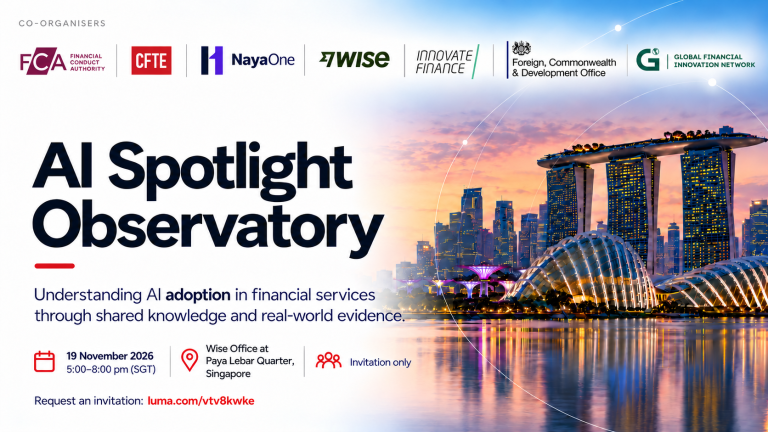
The AI Spotlight Observatory addresses that gap. Developed in the context of the UK Financial Conduct Authority’s AI Lab in collaboration with CFTE, it brings together a practical taxonomy and documented AI implementations so that institutions can describe and compare real-world AI applications consistently. It launches in Singapore on 19 November 2026, during Singapore FinTech Festival week.
What is the AI Spotlight Observatory?
The Observatory is a shared resource for understanding AI use cases in financial services. It has two parts:
- A practical taxonomy that classifies AI applications in a consistent way, so that a fraud model at one bank and a fraud model at another can be described and compared on the same terms.
- A repository of documented implementations, giving evidence about how AI is actually applied, rather than how it is marketed.
Together, they turn scattered experiments into a growing shared evidence base on AI in financial services.
Where it comes from: the FCA AI Lab
The FCA launched its AI Lab in January 2025 to deepen its understanding of the risks and opportunities AI presents to consumers and markets (FCA). The Lab includes several complementary initiatives:
Initiative | What it does |
AI Spotlight | Showcases innovation and makes relevant AI solutions visible |
Supercharged Sandbox | Helps firms experiment with advanced AI in a controlled environment, with NVIDIA computing |
AI Live Testing | Lets firms work with the FCA while deploying AI models |
Supercharged Academy | Developed with CFTE to build institutional and regulatory fluency among AI founders |
AI Spotlight Observatory | Provides a taxonomy and an evidence-led way to explore AI use cases |
The October 2026 UK-Singapore Financial Dialogue joint statement recorded progress under the two countries’ AI in Finance Partnership, including these initiatives, which is why the Singapore launch is a natural next step.
Why a shared evidence base matters
For regulators and central banks, a common taxonomy makes supervision more consistent and lets authorities in different jurisdictions compare notes on the same terms.
For financial institutions, documented implementations show what peers have tried, what worked and what governance they needed, which shortens the path from pilot to production.
For innovators, the evidence base helps explain products in terms that regulated buyers can evaluate, one of the hardest steps in scaling AI in finance (see our article “From Sandbox to Scale”).
The deeper point is that responsible AI adoption is not only a technical challenge. It is a capability challenge. Institutions that can describe, measure and compare their AI use are better placed to govern it.
The value of the Observatory is cumulative rather than immediate. A taxonomy becomes more useful the more institutions apply it, and a repository becomes more credible the more implementations it documents. Its impact should therefore be judged over time, by whether it helps regulators and institutions compare AI use more consistently, rather than by any single launch event.
How organisations can contribute
- Regulators and central banks can explore applying the taxonomy in their own supervisory work.
- Financial institutions can discuss contributing documented implementations.
- Researchers and experts can offer evidence and relevant questions.
To explore the right contribution route, request a meeting with CFTE during SFF week. Taking part in the Observatory does not imply FCA endorsement of any firm or product.
The Singapore launch
Event | AI Spotlight Observatory: Singapore launch |
Date and time | Thursday 19 November 2026, 17:00 to 20:00 SGT |
Format | Live demonstration, discussion and networking; invitation only, subject to host approval |
Audience | Regulators, central banks, financial institutions and industry experts |
Links |
Earlier the same day, an Observatory demonstration is planned at the invitation-led roundtable UK-Singapore AI in Finance: What Comes Next?, co-hosted by Innovate Finance and Hogan Lovells Cadwalader with FCA and MAS participation (subject to confirmation).
Shared evidence is a precondition for responsible AI at scale. By giving regulators and institutions a common way to describe and compare real-world AI use, the Observatory aims to move the conversation from claims about AI to evidence about it.
Frequently asked questions
What is the AI Spotlight Observatory?
It is a shared resource for understanding AI use cases in financial services, combining a practical taxonomy with documented AI implementations. It is developed in the context of the FCA AI Lab in collaboration with CFTE.
When is the Singapore launch?
Thursday 19 November 2026, from 17:00 to 20:00 SGT, during Singapore FinTech Festival week. It is invitation only; you can request an invitation through Luma.
Who can contribute to the Observatory?
Regulators and central banks can apply the taxonomy, financial institutions can contribute documented implementations, and researchers and experts can offer evidence and questions.
What is the FCA AI Lab?
Launched in January 2025, the FCA AI Lab is a set of initiatives to understand AI’s risks and opportunities and support safe AI innovation, including the AI Spotlight, the Supercharged Sandbox and AI Live Testing.
About CFTE
The Centre for Finance, Technology and Entrepreneurship (CFTE) is a global education company with a presence in London, Singapore and Abu Dhabi, dedicated to workforce transformation at scale.
Founded in 2017, CFTE believes that technological progress should create opportunities for everyone. As artificial intelligence and emerging technologies reshape industries and economies, CFTE works with governments, central banks, regulators and leading financial institutions to equip individuals, organisations and leaders with the capabilities to thrive in a changing world.
By bringing together leading industry practitioners, academic expertise and innovative learning approaches, CFTE bridges the gap between technological change and real-world application, enabling transformation from individual professionals to entire workforces.
CFTE has reached more than 200,000 participants across 130 countries.