
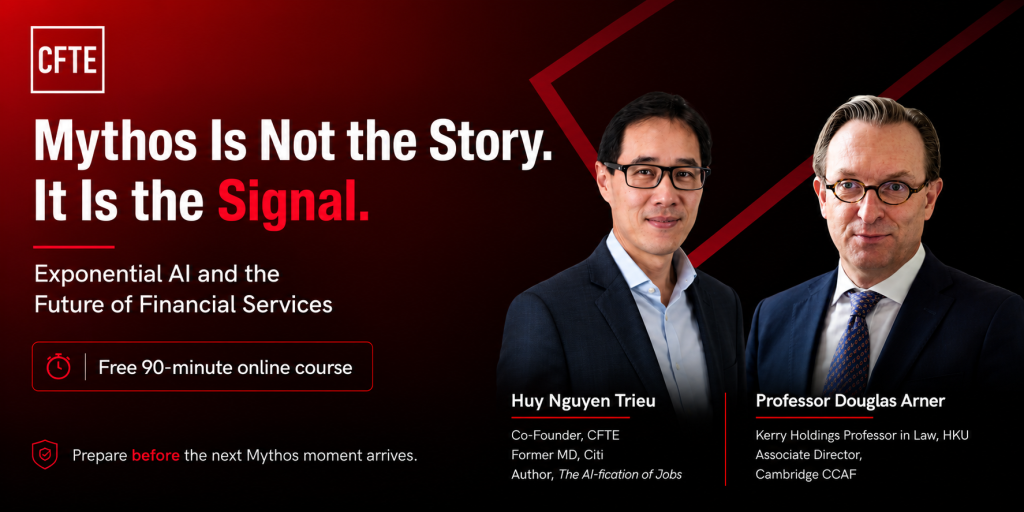
In early 2026, Mythos sent alarm bells across central banks, regulators, and financial institutions worldwide. Not because of how it became known, but because of what it could do.
Mythos was not designed as a cybersecurity tool. It was a general purpose model, the next step up from what millions of people use daily. Yet it could autonomously find and exploit vulnerabilities across virtually every major operating system and browser, without any human guidance, at a level exceeding the best human experts.
If a general purpose model could do this as a byproduct of its broader capabilities, what does the next generation look like?
Mythos is not the story. It is the signal.
Huy Nguyen Trieu
Co-founder, CFTE
Author, The AI-fication of Jobs
Former Managing Director, Citi
Prof. Douglas Arner
Kerry Holdings Professor in Law, University of Hong Kong
Associate Director, Cambridge Centre for Alternative Finance
Huy Nguyen Trieu and Professor Douglas Arner have spent decades working at the intersection of finance, technology, regulation, and innovation. Both believe the world is now entering a fundamentally new phase of AI. To help finance professionals understand what this shift means, and what to do about it, CFTE has made this course free.
The deeper issue
Exponential AI
Mythos points to something much larger. We have entered a third wave of AI, where systems can not only think and reason but act autonomously in the digital world. At the same time, AI is becoming ten to a hundred times more powerful and cheaper every year. What is impossible today could be possible tomorrow. Not tomorrow as a figure of speech. Tomorrow.
For financial services, this matters more than in almost any other sector. The industry is built on trust, risk management, regulation, and professional judgement. These are precisely the things exponential AI puts under pressure. Yet most firms and professionals are still responding incrementally. The sector had a decade to adapt to fintech. It has had roughly three years to move from AI to generative AI, to reasoning AI, to agentic AI. The pace will not slow down.
What the course covers
Huy opens by unpacking what Mythos revealed and why it signals something far larger. He introduces the three waves of AI, the concept of Exponential AI, and what it means for individuals and organisations to become anti-fragile in this environment.
Professor Arner then examines the implications for financial services specifically: why the sector was well positioned for the first wave, why that is no longer sufficient, and how different categories of risk, from malicious actors to infrastructure concentration to the loss of human expertise, require fundamentally different governance responses.
What you will learn
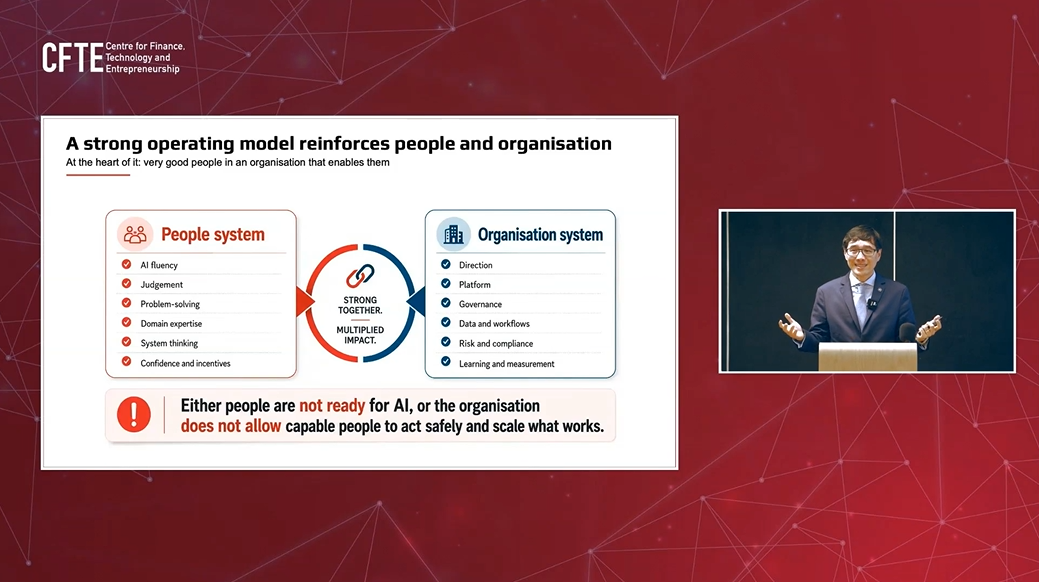
Key themes covered in the course
| What Mythos reveals about the third wave of AI and why it signals something much larger | |
| Why exponential AI makes linear planning obsolete and what a new strategic mindset looks like | |
| How to become a supercharged professional and why talent, not technology, is now the real differentiator | |
| The five categories of AI risk in financial services and why each requires a different governance response | |
| How institutions can move from AI-busy to AI-ready by rethinking their operating model |
Start the course today
1.5 hours · Self-paced · Free
