
Centre for Finance, Technology and Entrepreneurship | 9 June 2026
Today, Anthropic released Claude Fable 5 and Claude Mythos 5. This is not just another AI launch. It is one of the clearest signals yet that AI has entered a new phase, and financial services is directly in its path.
The most capable AI model ever made available to the public is now in everyone’s hands, more capable and far cheaper than the model before it. The single most important thing to understand is not the model itself. It is what the model signals. AI capability is now compounding faster than the governance frameworks, risk cycles, operating models, and skills that financial services was built on.
This article explains what launched, what a Mythos-class model is, why it matters for banks, regulators, and professionals, and what to do about it.
What did Anthropic actually launch?
Anthropic released two models. They are easy to confuse, and the difference matters.
Claude Fable 5 is the public model. It is a Mythos-class model that Anthropic has made safe for general use, and the company describes it as the most capable model it has ever made generally available. It is available to everyone today.
Claude Mythos 5 is not public. It is the same underlying model with its cybersecurity safeguards lifted, restricted to a small group of partners through Project Glasswing in collaboration with the US Government, with select biology researchers to follow.
So the headline matters: Mythos itself did not go public. A Mythos-class model, Fable 5, did. That distinction is the difference between a controlled frontier capability and a capability now sitting on every professional’s desk.
What is a Mythos-class model?
A Mythos-class model is a tier of capability that sits above Anthropic’s previous Opus class. The first, Claude Mythos Preview, was released in April 2026 to a limited set of cyber defenders and infrastructure providers because its capabilities were considered too powerful for open release. Fable 5 and Mythos 5 follow it.
According to Anthropic, Fable 5 is state of the art on nearly all tested benchmarks, with particular strength in software engineering, knowledge work, vision, and scientific research. The longer and more complex the task, the larger its lead over previous models. For finance specifically, Anthropic reports that Fable 5 tops Hebbia’s finance benchmark for senior level reasoning, with gains in document based reasoning, chart and table interpretation, and problem solving.
In plain terms: this is not an incremental upgrade. It is a step change in what a single professional can do.
Why is this the signal of exponential AI?
At CFTE we have been describing a shift we call the Third Wave of AI. It is the lens that makes today’s launch legible.
The first wave was machine learning, AI that could predict. The second wave was generative AI, AI that could reason, the moment most people met through ChatGPT. The third wave is AI that can act. It uses tools, runs multi step workflows, and executes in the digital world, not just answering questions but completing work.
Fable 5 is a clear marker of that third wave. Anthropic reports that an early tester, Stripe, used the model to perform a codebase wide migration across a fifty million line codebase in a single day, work that would otherwise have taken a team more than two months by hand.
Three forces are compounding this shift at the same time:
- AI is becoming sharply better. Capability that was state of the art months ago is now routine, and the hardest, longest tasks are where the newest models pull furthest ahead.
- AI is becoming sharply cheaper. Fable 5 launched at less than half the price of the model before it, at 10 dollars per million input tokens and 50 dollars per million output tokens.
- AI is becoming sharply more autonomous. Models now sustain useful work across long, complex tasks rather than short bursts.
When capability rises and cost falls at the same time, year after year, the result is exponential, not linear. That is the real story. The model is only the signal.
What does exponential AI mean for financial services?
Financial services has invested in AI for years. The challenge now is not access to the technology. It is the capability to use it well, govern it, and turn activity into execution.
Three implications stand out.
Governance is now a moving target. Anthropic released Fable 5 to the public while deliberately gating Mythos 5 and routing sensitive cyber, biology, and chemistry queries to a more constrained model. A frontier lab choosing to release one model and restrict another is a live example of the governance question every regulated institution now faces. Risk frameworks built for annual cycles are being tested by capabilities that change month to month.
Performance is being redefined. When one professional with the right tools can do what once took a team, the definition of high performance changes. This is the heart of CFTE’s work on the AI-fication of Jobs and the emergence of what we call Supercharged Professionals, people who combine deep domain judgment with real AI leverage.
The workforce will split three ways at once. Using the CDE Innovation Prism, a framework for how technology reshapes work, we expect three patterns to happen simultaneously: displacement where AI competes directly with tasks, a small number of creative disruptors, and a growing class of supercharged professionals. The dividing line between them is not access to AI. It is the capability to use it well.
Prepare before the next Mythos moment
CFTE has been preparing financial services for this shift for years. We identified AI as the single most important technology impacting financial services in 2018, and have built the frameworks and programmes to turn that conviction into institutional capability ever since.
The gap that decides who thrives in exponential AI is capability, and capability can be built deliberately.
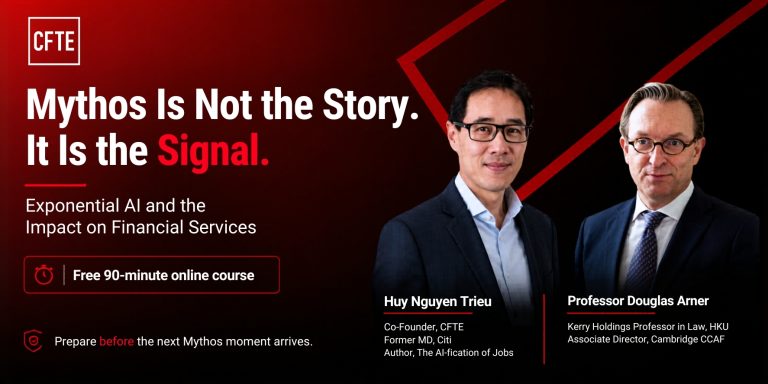
CFTE co-founder Huy Nguyen Trieu and Professor Douglas Arner of the University of Cambridge recorded a free 90 minute course, Exponential AI and the Impact on Financial Services, before today’s launch. It explains the Three Waves of AI, the forces compounding them, how regulators are responding, and how individuals and institutions can move from watching to building. It is free and includes a certificate.
Access the course and find more information here: https://courses.cfte.education/exponential-ai-and-the-impact-on-finance/
Frequently asked questions
Is Claude Mythos available to the public?
No. The public model is Claude Fable 5, a Mythos-class model made safe for general use. Claude Mythos 5, the version with cybersecurity safeguards lifted, is restricted to selected partners through Project Glasswing and the US Government.
What is exponential AI?
Exponential AI describes the pattern of AI becoming sharply more capable and sharply cheaper at the same time, year after year, so that what is impossible today can become routine in a matter of months rather than decades.
Why does the Fable 5 launch matter for finance?
Because the most capable AI model ever made public is now available to every institution and professional, at less than half the previous price, and it can complete complex work rather than only assist with it. This compresses the gap between large and small institutions and tests governance frameworks built for slower change.
Why does CFTE call this a signal of Exponential AI?
Because the release is not only about one model. It shows a broader pattern: AI capability is improving faster, becoming more widely available and affecting more complex tasks. That is the core idea behind Exponential AI.
