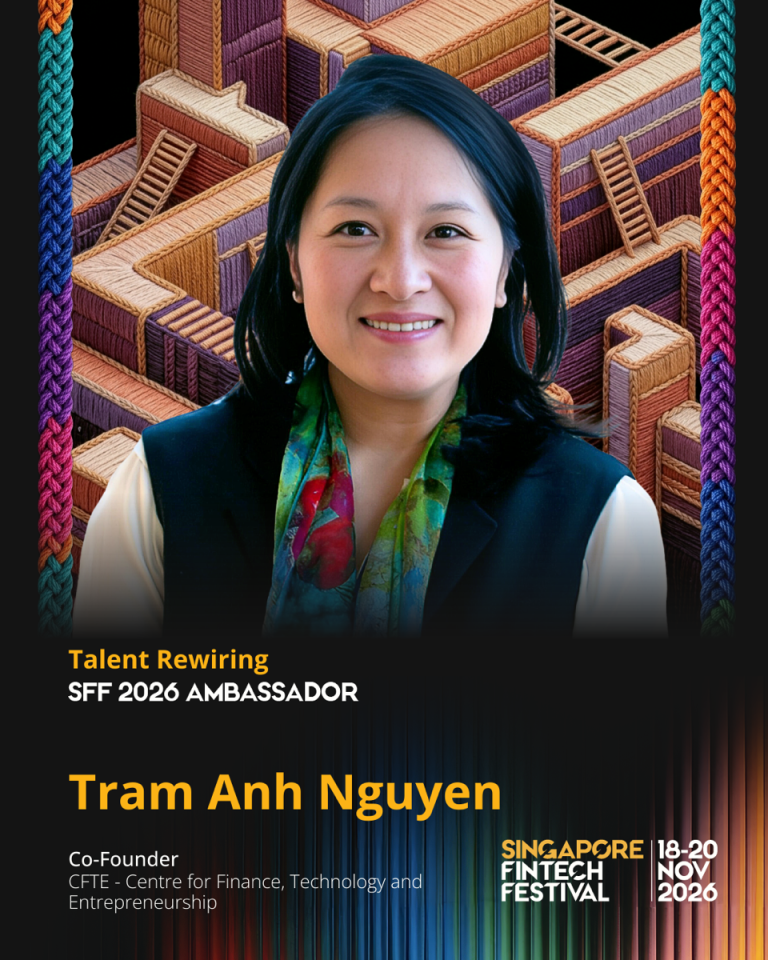
Talent Rewiring is one of the five themes of the Singapore FinTech Festival 2026 (SFF 2026), held from 18 to 20 November at Singapore EXPO. It asks a simple question with large consequences: as AI transforms jobs, how can financial institutions build the skills and capabilities of their workforce to stay competitive? For finance professionals, the theme is also a personal question about which skills will keep their careers moving.
CFTE co-founder Tram Anh Nguyen is an SFF 2026 Ambassador for Talent Rewiring. This article explains what the theme covers, why it has become urgent, and what it means in practice for people working in finance.
What is Talent Rewiring?
SFF 2026 is organised by the Monetary Authority of Singapore (MAS) and GFTN around the theme “The Coming Rewiring of the Financial System: New Risks. New Rules. New Growth.” It identifies five forces reshaping finance at the same time: Technology, Geoeconomic, Capital, Talent and Policy Rewiring (MAS media release).
The Talent Rewiring track focuses on building the workforce of the future. Its sessions include the Festival Stage discussion “From Digital to Intelligent: Who Will Build the Next Financial System?” on 18 November, the Global FinTech Hackcelerator, and a panel on skills and talent development for generative AI on 19 November.
Why talent needs rewiring now
Three pieces of evidence explain why talent has become a headline theme:
- Skills are changing fast. Employers in the World Economic Forum’s Future of Jobs Report 2025 expect 39 percent of key skills to change by 2030. The same report projects 170 million jobs created and 92 million displaced this decade.
- Tasks in finance are highly exposed. Research for HM Treasury by the UK’s Financial Services Skills Commission found that up to half of the tasks in most financial services roles could be automated by AI (FSSC).
- Financial centres are acting at scale. In September 2026, 23 Singapore financial institutions in the IBF AI Workforce Co-Lab committed to train over 80,000 employees in AI by 2028. In July, 22 UK firms signed the Financial Services Skills Compact to upskill their entire UK workforces in AI over three years (see our article “How Singapore, the UK and the UAE Are Training Their Workforces for AI”).
What Talent Rewiring means for finance professionals
Skills are not the same as capability
Learning to use AI tools matters, but it is not enough. Skills are knowing how to use the tool. Capability is knowledge, judgement, adaptability and the ability to act when conditions change. As CFTE co-founder Huy Nguyen Trieu puts it, a task executor who adds AI becomes a faster task executor, which is not the same as having a job in five years.
How you contribute matters more than your job title
CFTE’s Performance Hexagon sorts contributors by how they work rather than what they are called: underperformers, task robots, problem solvers, systems thinkers and superstars. In a world of AI, roles built on executing well-defined tasks are the most exposed, while people who solve problems independently, build systems and spot opportunities are amplified. Klarna’s experience shows the pattern: of around 1,000 customer service agents, roughly 700 were replaced by AI while around 300 took on more responsibility, in the same role.
Domain expertise becomes more valuable, not less
AI can produce an answer quickly. Only someone who knows the domain can tell whether it is right. Experienced professionals who can structure a problem and delegate to AI are often doing very well; people without that depth struggle to judge the output (see our article “Why Domain Expertise Matters More Than Age in an AI Workplace”).
The practical implication is that Talent Rewiring cannot be reduced to a training catalogue. Institutions can count course completions easily; it is harder, and more important, to know whether people can redesign their work, judge AI output and take responsibility for decisions. The evidence above points to capability, not tool familiarity, as the dividing line between roles that are amplified and roles that are exposed.
Five practical steps to rewire your own skills
- Benchmark where you are. Use a structured tool such as CFTE’s AIQ assessment or the levels in the CFTE AI Proficiency Framework.
- Build AI literacy first, then apply it. Start with safe, disciplined use, then move quickly to applying AI in your actual workflows.
- Redesign one workflow end to end. Pick a recurring task and rebuild it with AI, measuring time saved and quality.
- Invest in judgement skills. Systems thinking and first-principles thinking compound as tools change.
- Pair your domain with AI. You already have a field. The future belongs to AI-bilingual professionals who understand both their field and how AI transforms it.
What Talent Rewiring means for institutions
For financial institutions, Talent Rewiring means treating capability as infrastructure: defined through a proficiency framework, delivered through role-based pathways tied to real workflows, and measured through diagnostics rather than assumed. CFTE works with financial institutions, regulators and governments on exactly this, through the AI Capability Diagnostic, IBF-accredited AI programmes and workforce transformation at scale.
Talent Rewiring and CFTE at SFF 2026
Tram Anh Nguyen joins the Insights2040 roundtable “Is AI Pulling the Ladder Up? Reimagining Job-Ready Skills in the AI Transition” on 17 November, and CFTE’s full programme is on the CFTE SFF 2026 page. Use partner code CP-DISC-20-CFTE for 20 percent off SFF 2026 delegate passes.
Talent Rewiring is ultimately a question of readiness rather than awareness. Financial institutions and professionals already know AI is changing work; the harder task is building the capabilities, leadership and measurement that turn that awareness into confident, responsible use. That is the work CFTE brings to SFF 2026.
Frequently asked questions
What are the five themes of SFF 2026?
Technology Rewiring, Geoeconomic Rewiring, Capital Rewiring, Talent Rewiring and Policy Rewiring, under the overall theme “The Coming Rewiring of the Financial System”.
What does Talent Rewiring mean?
It is the SFF 2026 theme on building the workforce of the future: how financial institutions can build their people’s skills and capabilities as AI transforms jobs.
Who is the SFF 2026 Ambassador for Talent Rewiring?
Tram Anh Nguyen, co-founder of CFTE and Chairwoman of Global Women in AI, is an SFF 2026 Ambassador for Talent Rewiring.
What skills matter most for finance professionals in the AI era?
AI literacy and applied AI skills, combined with domain expertise, judgement, systems thinking and adaptability. Tool skills alone are not enough.
About CFTE
The Centre for Finance, Technology and Entrepreneurship (CFTE) is a global education company with a presence in London, Singapore and Abu Dhabi, dedicated to workforce transformation at scale.
Founded in 2017, CFTE believes that technological progress should create opportunities for everyone. As artificial intelligence and emerging technologies reshape industries and economies, CFTE works with governments, central banks, regulators and leading financial institutions to equip individuals, organisations and leaders with the capabilities to thrive in a changing world.
By bringing together leading industry practitioners, academic expertise and innovative learning approaches, CFTE bridges the gap between technological change and real-world application, enabling transformation from individual professionals to entire workforces.
CFTE has reached more than 200,000 participants across 130 countries.