
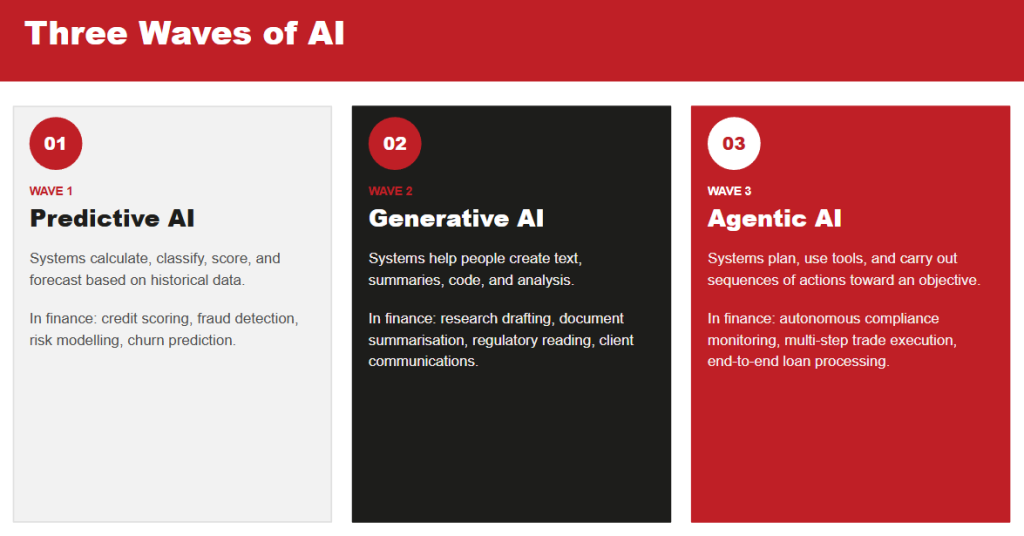
From Prediction to Cognition to Autonomy
Artificial intelligence is not a single technology. It is a shifting landscape of capabilities that has evolved through distinct phases, each unlocking new possibilities for businesses, institutions, and society. At CFTE, we frame this evolution as three waves, a progression defined not by the algorithms alone, but by the degree of autonomy AI holds in relation to human decision-making.
Understanding where we have been, where we are, and where we are heading is essential for anyone navigating the future of finance and technology. Here is how we see it.
The First Wave: Predictive AI
Machine Learning | 2010s — Present
The first wave of AI was built on a simple but powerful premise: if you feed a machine enough historical data, it can learn to recognise patterns and make predictions. This is the era of machine learning — supervised models, neural networks, gradient boosting, and the statistical engines that transformed industries from the 2010s onward.
In finance, this wave gave us credit scoring, fraud detection, algorithmic trading, and demand forecasting. In technology, it powered recommendation engines, search ranking, and ad targeting. The common thread was that humans defined the problem, selected the features, and acted on the outputs. The AI optimised within tightly scoped boundaries.
Predictive AI was transformative, but narrow. Each model performed one task. It could not reason, create, or understand language. It calculated.
The Second Wave: Cognitive Assisted
Generative AI | 2020 — Present
The second wave arrived with a qualitative leap: AI that could understand and generate human language, images, and code. Powered by large language models, transformers, and foundation models fine-tuned through reinforcement learning from human feedback (RLHF), this wave turned AI into a thinking partner.
Rather than simply classifying inputs or forecasting outputs, cognitive assisted AI can draft documents, summarise research, write and debug code, answer complex questions, and engage in multi-turn reasoning. It augments human cognition, hence the name.
The critical distinction from the first wave is the nature of the interaction. Where predictive AI delivers a number or a label, generative AI delivers language, ideas, and creative output. But the human remains in the loop. You prompt, it responds. You review, it revises. The AI assists; it does not act independently.
This is the wave we are living through now, the era of copilots, chatbots, and AI-assisted workflows that are reshaping every knowledge profession from legal to consulting to software engineering.
The Third Wave: Agentic AI
Cognitive Autonomy + Execution | 2025 — Emerging
The third wave is the one now taking shape, and it represents the most consequential shift yet: AI that does not wait to be prompted. Agentic AI can plan, reason, use tools, and execute multi-step workflows to achieve goals with minimal human oversight.
Where the second wave gave us a brilliant assistant that responds to questions, the third wave gives us a capable colleague that pursues objectives. You set the goal and the guardrails. The AI figures out how to get there, breaking the task into steps, selecting the right tools, adapting when things go wrong, and delivering results.
This is not science fiction. We are already seeing early agentic systems in autonomous research workflows, multi-agent orchestration platforms, and self-managing software systems. The underlying technologies, tool-use frameworks, memory-augmented agents, reinforcement learning, and multi-agent architectures — are maturing rapidly.
The limitation is not capability but governance. Trust, safety, accountability, and regulatory frameworks are still catching up. The organisations that thrive in this wave will be those that learn to set the right objectives and build the right guardrails, not those that try to keep humans in every loop.
The Unifying Thread: Autonomy
Across all three waves, the defining axis is autonomy. Each wave does not replace the last, it builds on it. Agentic AI uses generative models under the hood, which in turn rely on the machine learning foundations of the first wave. What changes is how much independence AI has in the workflow:
Wave 1: AI calculates. Wave 2: AI thinks with you. Wave 3: AI acts for you.
This progression has profound implications for how organisations design roles, allocate talent, manage risk, and create value. The skills needed to supervise an AI copilot are different from the skills needed to govern an autonomous agent.
What This Means for Finance and Business
For professionals in finance and technology, the transition from wave two to wave three is the most urgent challenge on the horizon. The second wave has already reshaped how we work. The third wave will reshape what work is.
Organisations that understand this trajectory can prepare: investing in the governance frameworks, talent strategies, and technology infrastructure that agentic AI demands. Those that do not will find themselves reacting to a transformation they did not see coming.
At CFTE, we believe that education is the bridge between where AI is today and where it is going. Understanding the three waves is the first step.
About CFTE
The Centre for Finance, Technology and Entrepreneurship (CFTE) is a global platform that builds capabilities in finance and technology. Headquartered in London, with offices in Singapore and Abu Dhabi, CFTE works with governments, regulators, and financial institutions to design frameworks, programmes, and learning systems that support transformation at scale. CFTE’s programmes have reached learners in more than 130 countries.
