
AI readiness in financial services is not just a technical challenge.
It is an institutional one.
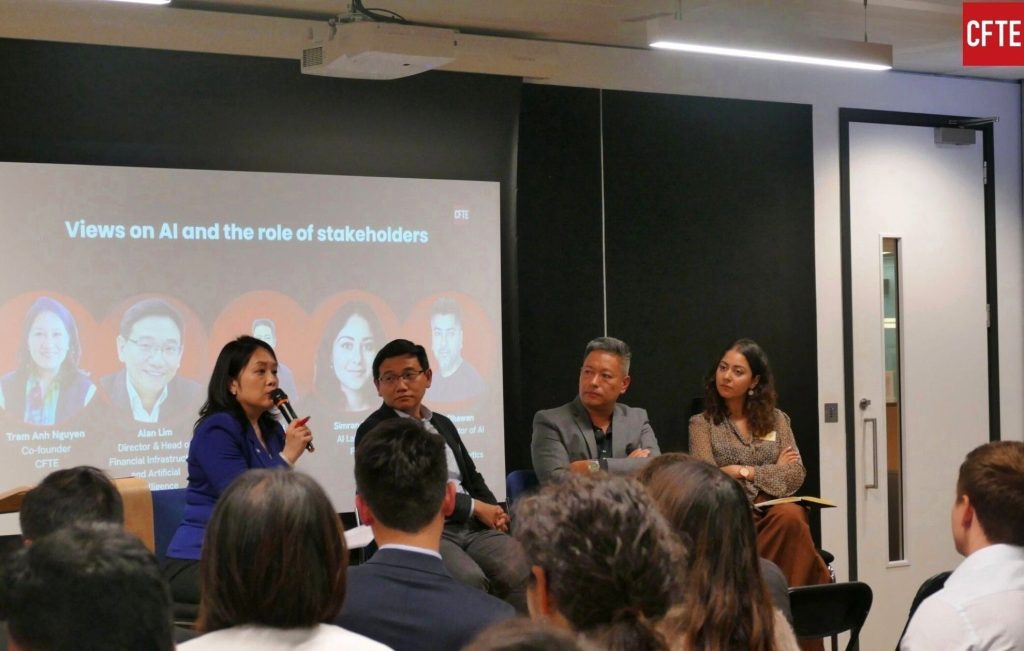
At CFTE’s UK–Singapore Exchange, a panel featuring leaders from the Monetary Authority of Singapore, the Financial Conduct Authority, and Trust Bank explored a critical question: what does it actually take to build an AI-ready financial system?
The discussion made one point clear. The future of AI in finance will not be shaped by technology alone. It will depend on whether institutions, regulators, and innovators can build the conditions for responsible adoption at scale.
The Role of Regulators Is Evolving
As AI becomes more embedded in financial services, the role of regulators is also changing.
Simran Singh from the Financial Conduct Authority described the regulator’s role not simply as enforcing rules, but as:
“Shaping the conditions for AI to be deployed responsibly and effectively at scale.”
This reflects an important shift.
In a fast-moving AI environment, regulation is not only about setting boundaries. It is also about helping the market understand expectations, translate principles into practical guidance, and create the confidence needed for responsible innovation.
This includes:
- translating regulatory principles into practical guidance
- signalling expectations to the market
- convening stakeholders across the ecosystem
- supporting shared understanding of risks and opportunities
Alan Lim from the Monetary Authority of Singapore reinforced this perspective. He highlighted that regulators are increasingly acting as enablers of innovation, coordinators of ecosystems, and contributors to capability-building.
This is especially important in financial services, where innovation must operate within systems built on trust, resilience, and accountability.
Governance Is Not the Constraint
A key theme across the panel was the role of governance.
Governance is often seen as something that slows innovation down. But the discussion challenged this view.
In AI adoption, strong governance can be what enables institutions to move faster. It builds trust, reduces uncertainty, clarifies accountability, and gives organisations the confidence to scale.
Without governance, AI may remain trapped in pilots and experiments. Institutions may hesitate to deploy solutions because they are uncertain about risks, controls, responsibilities, or regulatory expectations.
With the right governance, innovation becomes easier to scale responsibly.
As one panellist noted, understanding risks allows institutions to move faster with confidence. This is a critical point for financial services. AI readiness is not about ignoring risk. It is about understanding risk well enough to act.
The Hidden Challenge: Organisational Readiness
While AI technology continues to advance rapidly, the panel identified a deeper challenge.
It is often easier to build AI systems than to build organisations that can absorb them.
This is one of the most important issues facing financial institutions today. Many organisations have access to AI tools, models, and technical capabilities. But that does not automatically make them ready to deploy AI effectively.
AI adoption requires organisational readiness.
That includes aligning teams, improving data coherence, integrating governance, adapting operating models, and ensuring that people understand how AI should be used in practice.
Without this foundation, even strong AI solutions may fail to scale. They may remain isolated in pilots, disconnected from core workflows, or unable to meet the governance standards required in regulated environments.
The challenge, therefore, is not only to build AI systems. It is to build institutions that are capable of using them responsibly.
From Technical Adoption to System Integration
The panel highlighted that AI readiness requires integration across the organisation.
AI cannot sit only within technology teams. It needs to connect with compliance, risk, operations, legal, product, customer experience, and leadership.
This is because AI affects more than processes. It affects decision-making, accountability, customer outcomes, operational resilience, and trust.
For AI to create real value, institutions need to understand where it fits, who owns it, how it is governed, how it is monitored, and how it supports wider strategic objectives.
This requires a shift from isolated AI adoption to system-wide integration.
The organisations that succeed will not be those that simply deploy the most tools. They will be those that embed AI into their operating models in a way that is coherent, governed, and trusted.
Collaboration as a Competitive Advantage
Another strong message from the panel was that no institution can build AI alone.
Effective AI adoption requires collaboration across regulators, financial institutions, and technology providers.
This is particularly important in regulated environments. Shared standards, common frameworks, and open dialogue can help reduce uncertainty and accelerate responsible adoption.
Regulators can help clarify expectations and convene the ecosystem. Financial institutions can bring real-world use cases, operational knowledge, and customer context. Technology providers can contribute technical capability and innovation.
When these groups work together, AI adoption becomes more practical, more responsible, and more scalable.
In this sense, collaboration is not simply a nice-to-have. It is becoming a competitive advantage.
The Takeaway
AI readiness is not achieved through technology alone.
It depends on governance, capability, collaboration, and organisational change.
The panel at CFTE’s UK–Singapore Exchange showed that building an AI-ready financial system requires regulation and innovation to move together. Regulators must help create the conditions for responsible deployment, while institutions must build the internal capacity to adopt AI safely and effectively.
The future of financial services will not be shaped by who adopts AI first.
It will be shaped by who integrates it most effectively across the system.
