
AI at scale is not only about building better models.
It is about embedding intelligence into real financial infrastructure.
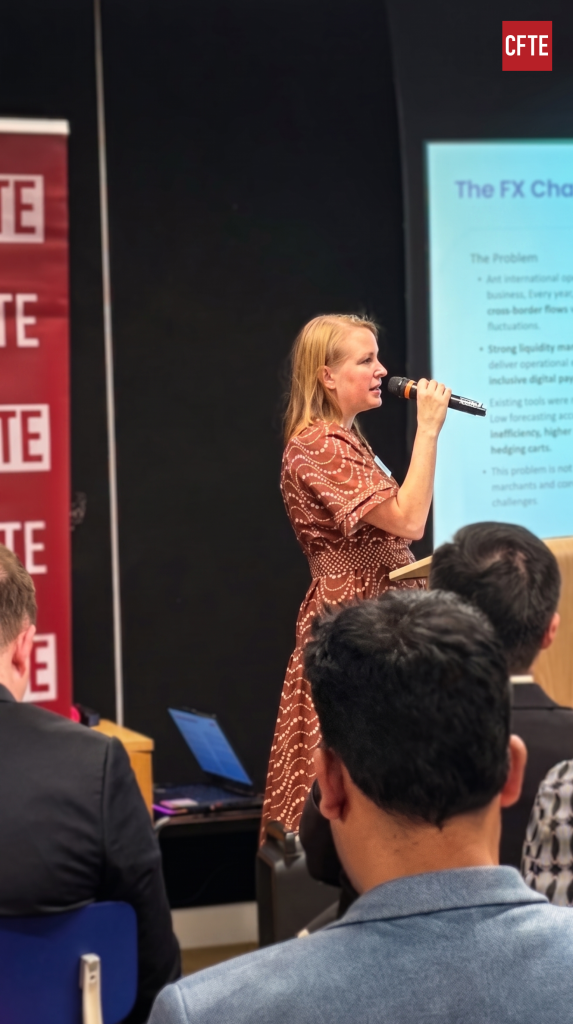
At CFTE’s UK–Singapore Exchange, Agnes Bastaert from Ant International demonstrated what AI looks like when it is deployed at scale to solve a complex, high-impact problem: foreign exchange risk.
Her example showed how AI can move beyond experimentation and become part of the operating infrastructure that supports global financial flows.
The Problem: FX Risk at Scale
Cross-border payments create significant operational and financial challenges.
At Ant International, the scale is substantial, with $1.4 trillion in cross-border flows. Each transaction can carry foreign exchange risk and liquidity challenges, especially when flows move across markets, currencies, and time zones.
For many businesses, particularly small and medium-sized enterprises, FX volatility is not just a technical issue. It can directly affect margins, planning, and commercial viability.
When exchange rates move unexpectedly, businesses may face higher costs, reduced certainty, and greater difficulty managing international operations. At scale, these risks become even more complex.
This is where AI can play a meaningful role.
From Data to Forecasting
Agnes presented Falcon TST, a Time Series Transformer designed to help predict transaction flows and support better liquidity and hedging decisions.
The system analyses real-world signals, including:
- transaction data
- e-commerce activity
- travel patterns
By combining these inputs, Falcon TST can identify patterns in cross-border activity and forecast future transaction flows more accurately.
This matters because better forecasting can support better financial decision-making. If institutions can anticipate flows more effectively, they can manage liquidity more efficiently and reduce the cost of hedging.
In this context, AI is not being used as a standalone tool. It is being embedded into the financial infrastructure that supports real-time, cross-border activity.
From Prediction to Impact
The results shared by Agnes demonstrated the practical value of applying AI to FX risk management.
Falcon TST achieved:
- 93% forecast accuracy
- less than 1% error on critical cases
- 40% reduction in hedging costs in pilot testing
These figures show why AI at scale matters.
The value does not come only from prediction. It comes from connecting prediction to operational and financial outcomes. In this case, more accurate forecasting can help reduce hedging costs, improve liquidity management, and support businesses operating across borders.
This is the difference between AI as a concept and AI as infrastructure.
Collaboration Across the Ecosystem
One of the most important insights from the example was the role of collaboration.
Ant International’s approach is not about replacing banks. Instead, it is about strengthening the financial ecosystem by allowing different players to contribute where they are strongest.
Ant provides intelligence through data-driven forecasting and infrastructure. Banks continue to execute transactions and provide financial services.
This creates a model of shared value.
Rather than positioning AI as a disruptive force that removes existing institutions, the example showed how AI can support stronger partnerships between technology firms, financial institutions, and businesses.
What AI at Scale Really Means
Agnes’ presentation offered a practical view of what AI at scale looks like in financial services.
It is not simply about deploying a model. It is about integrating real-world data, applying intelligence to complex financial problems, and embedding AI into the systems that support global activity.
For financial services, this is an important shift.
AI adoption is moving from experimentation to operational deployment. The most valuable use cases will not only be those that demonstrate technical performance, but those that solve real problems, reduce costs, improve resilience, and create value across the ecosystem.
The Takeaway
AI at scale is not just about models.
It is about integrating real-world data, embedding intelligence into financial infrastructure, and collaborating across the ecosystem.
Agnes Bastaert’s example from Ant International showed how AI can be applied to one of the most complex challenges in cross-border finance: managing FX risk at scale.
The future of AI in financial services will be shaped by solutions that move beyond experimentation and deliver measurable impact in real-world environments
