
AI readiness is not just a technology question.
It is a system transformation question.
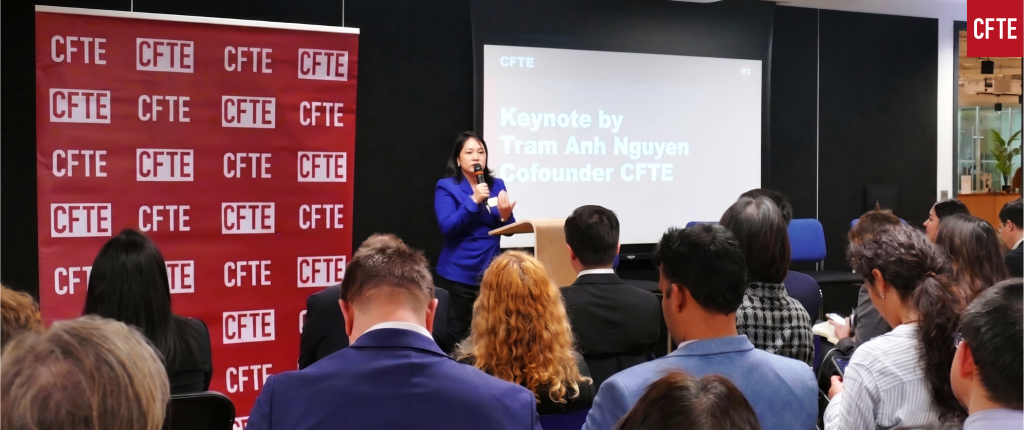
At the opening of CFTE’s UK–Singapore Exchange, Tram Anh Nguyen reframed the conversation around AI in financial services. Her message was clear: the industry is moving beyond asking whether AI matters. The real challenge now is how the entire financial system evolves together.
As AI advances, financial institutions cannot rely on isolated pilots, disconnected tools, or individual experimentation alone. These efforts may create momentum, but they do not necessarily create readiness.
To prepare for the next phase of AI adoption, organisations need a more structured and system-wide approach.
Moving Beyond Isolated Pilots
Many organisations are already experimenting with AI.
They are launching pilots, testing tools, encouraging teams to explore new use cases, and identifying areas where AI could improve productivity or decision-making.
These initiatives are valuable. They help organisations learn, build confidence, and understand where AI may create impact.
But experimentation alone is not enough.
One of the key risks Tram Anh highlighted is that AI adoption can become fragmented. Different teams may use different tools, follow different approaches, and develop different levels of understanding. Without coordination, AI activity can grow quickly without becoming part of a coherent transformation strategy.
This is why AI readiness must be treated as a system-level challenge.
The question is no longer only whether an organisation has AI tools. It is whether the organisation has the structures, skills, governance, and collaboration needed to use AI responsibly and at scale.
The Four Pillars of AI Readiness
Tram Anh introduced a framework that captures what true AI readiness requires.
The first pillar is understanding. Organisations need to understand how AI is transforming financial services, jobs, skills, workflows, and customer expectations. This goes beyond awareness. It requires a deeper analysis of how AI changes the way people work and how institutions create value.
The second pillar is structuring. As AI adoption accelerates, organisations need frameworks, taxonomies, and capability models that help make sense of complexity. Without structure, it becomes difficult to compare use cases, assess maturity, identify risks, or understand where AI is creating value.
The third pillar is delivery. AI readiness requires practical capability-building. This means scaling learning through programmes, academies, workshops, and hands-on training that help professionals move from theory to execution.
The fourth pillar is convening. No single institution can solve the AI transition alone. Regulators, financial institutions, technology providers, educators, and innovators need spaces to exchange knowledge, align expectations, and build shared understanding.
Together, these four pillars reflect CFTE’s broader work in capability-building: helping individuals and organisations move from awareness to execution.
From Use Cases to System Change
A key shift highlighted during the session was the need to move from discussing AI use cases to building AI-ready systems.
Use cases matter. They help organisations understand where AI can create value. But if they remain disconnected from governance, talent, strategy, and organisational design, they will not create lasting transformation.
AI-ready systems require more than individual tools. They require:
- governance frameworks
- talent transformation
- organisational alignment
- capability development
- cross-border collaboration
- shared language across the ecosystem
This is especially important in financial services, where AI adoption must be responsible, explainable, and aligned with regulatory expectations.
The next phase of AI in finance will not be defined only by the number of experiments taking place. It will be defined by whether institutions can build the systems needed to scale AI safely and effectively.
Why This Matters Now
AI is not evolving incrementally.
It is evolving exponentially.
This creates a new kind of challenge for financial services. Change cycles are becoming faster. Uncertainty is increasing. The stakes for governance, skills, and institutional readiness are becoming higher.
Without a structured approach, organisations risk falling behind not because they lack access to AI tools, but because they lack coordination.
They may have pilots, but no pathway to scale. They may have technology, but no shared understanding. They may have use cases, but no governance model. They may have ambition, but no system for execution.
This is why AI readiness needs to be understood as a transformation challenge.
It requires institutions to align people, processes, technology, governance, and strategy around a common direction.
Building AI-Ready Financial Systems
Tram Anh’s message also reflected a broader reality: AI adoption in finance is not only an institutional challenge. It is an ecosystem challenge.
Financial services involves many interconnected stakeholders, including banks, fintechs, regulators, technology providers, educators, investors, and customers. AI will affect all of them.
For AI to scale responsibly, these stakeholders need to evolve together.
This means creating common frameworks, building shared capabilities, developing trusted governance approaches, and enabling collaboration across markets.
Events such as the UK–Singapore Exchange play an important role in this process. They create the space for leaders, innovators, and institutions to exchange perspectives, compare approaches, and build the foundations for responsible AI adoption.
The Takeaway
AI readiness is not about adopting a tool.
It is about aligning systems, people, and institutions.
Tram Anh Nguyen’s opening remarks at CFTE’s UK–Singapore Exchange made clear that the organisations that succeed in the next phase of AI adoption will not simply be those experimenting the most.
They will be those building the most coherent systems around AI.
The future of financial services will depend not only on what AI can do, but on how effectively the industry prepares itself to use AI responsibly, collaboratively, and at scale.
