
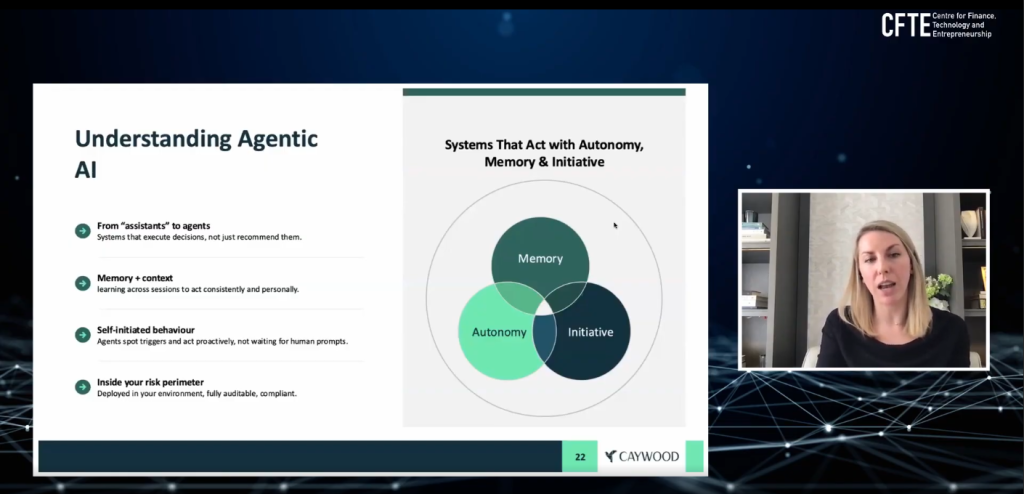
In a recent CFTE webinar on Generative AI in finance, Megan Caywood explored why Agentic AI could reshape financial services even more deeply than the internet era.
Drawing on her experience as Founder & CEO of Caywood, former Chief Product Officer at Barclays, and former Chief Platform Officer at Starling Bank, Megan explained how finance is moving from systems that assist users to systems that can act on their behalf.
Her central argument was that the next transformation in finance will not just be about better user experience. It will be about delegation.
From Digital Banking to Agentic AI
Megan began by reflecting on the last wave of change in finance. Challenger banks such as Starling, Monzo and Revolut transformed customer expectations through mobile-first design, real-time visibility and simpler banking experiences.
But while digital banking made finance easier to access, it did not remove complexity. Customers still manage fragmented products, platforms and decisions.
Agentic AI, Megan argued, could change that.
From Interaction to Delegation
A key distinction she made was between Generative AI and Agentic AI.
Generative AI helps users interact with information. Agentic AI goes a step further by enabling systems to execute tasks autonomously.
In finance, that could mean systems that monitor triggers, compare options, support planning and act across connected services. This is a shift from recommendation to execution.
Why Finance Is Ready
One of Megan’s strongest points was that finance already has much of the infrastructure needed for this next phase. Open banking, APIs and connected digital systems now provide the rails that intelligent agents can operate on.
Rather than simply creating more dashboards or apps, Agentic AI opens the door to orchestration across the financial ecosystem.
Trust Will Define Adoption
Megan also stressed that trust, transparency and governance will be essential. If AI systems are to act on behalf of customers or institutions, they must be auditable, explainable and well-governed.
In finance, human oversight will remain critical, not as a blocker to progress, but as stewardship.
5 Key Takeaways
- Agentic AI shifts finance from interaction to delegation.
- The next wave is about execution, not just assistance.
- Finance already has the digital rails to support this shift.
- Orchestration may matter more than building new platforms.
- Trust, transparency and governance will be essential.
As finance enters its next stage of transformation, Megan Caywood’s session made one thing clear: the future may not be shaped only by better tools, but by intelligent systems that can help carry out decisions across an increasingly complex financial world.
