
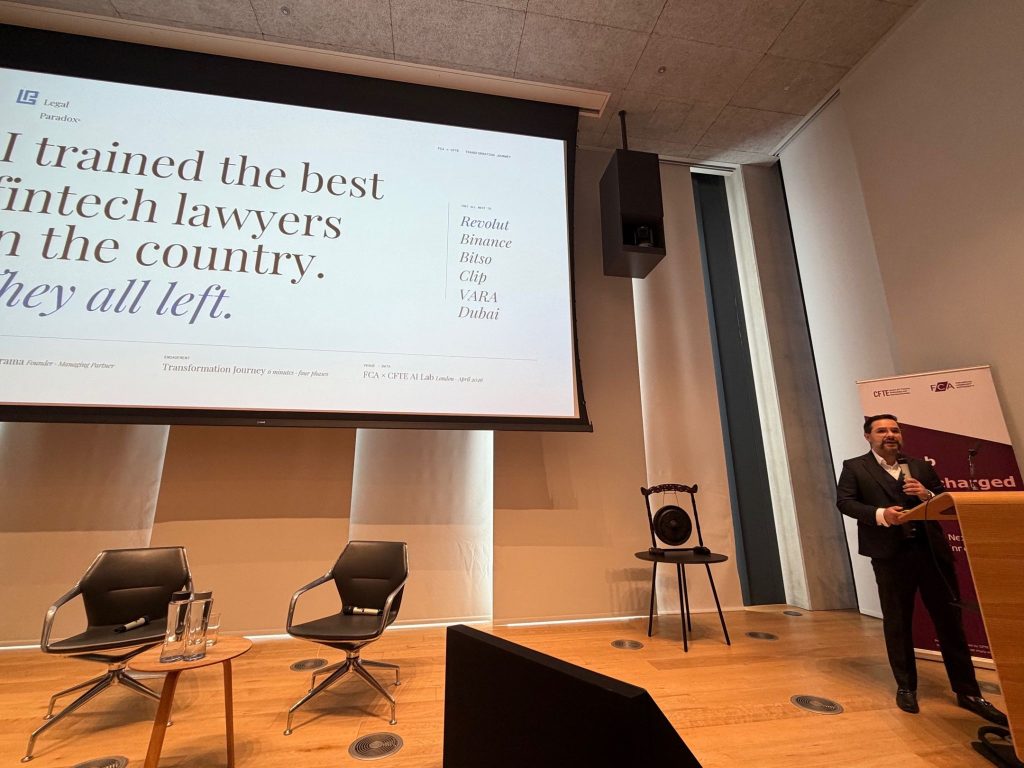
At the Financial Conduct Authority AI Lab Supercharged Academy, delivered in collaboration with CFTE, Carlos Valderrama, Founder and CEO of Legal Paradox®, was recognised for his outstanding work in applying AI to one of the most complex and highly regulated professional sectors: legal services.
Out of 60 global projects, only four were selected to be showcased to the international financial services and innovation ecosystem.
Legal Paradox® was one of them.
This recognition marks an important milestone for Carlos and his team. But more importantly, it reflects a broader shift in how artificial intelligence is being designed, deployed, and governed in regulated environments.
More Than a Programme Milestone
The recognition of Legal Paradox® goes beyond participation in a programme.
It signals the growing importance of AI solutions that are not only innovative, but also reliable, auditable, and ready for real-world deployment.
In legal services, as in financial services, trust is fundamental. Professionals and institutions cannot rely on AI systems that are vague, inconsistent, or difficult to verify. They need systems that can operate with a high degree of accuracy, transparency, and accountability.
This is where the work of Carlos Valderrama and Legal Paradox® stands out.
Rather than simply exploring what AI could do in law, they are focused on operationalising AI — building AI-native legal infrastructure that can support practical use cases in complex professional environments.
Their work is grounded in principles that are essential for regulated sectors, including:
- verifiable rules
- reliability
- auditability
- performance
- real-world deployment
These are not optional features. In legal and financial services, they are foundational requirements.
AI in Highly Regulated Environments
Legal services depends on trust, precision, and accountability.
When AI is introduced into this environment, the expectations are high. Systems must be explainable, testable, and accountable. They must support professionals in making better decisions while maintaining the standards required by clients, regulators, and institutions.
This is why building AI for regulated environments is fundamentally different from building AI for general use.
In sectors such as law and finance, AI cannot simply produce plausible answers. It must be designed to perform consistently, follow clear rules, and provide confidence in its outputs.
Carlos’ work demonstrates how AI can be developed for environments where governance and accuracy matter deeply. It shows that the future of AI adoption will not only depend on technical capability, but also on the ability to build systems that professionals can trust.
A Global Signal for AI Innovation
Legal Paradox®’s recognition also sends an important global message.
AI innovation is not limited to one region, one market, or one type of institution. It is emerging from diverse ecosystems around the world, led by entrepreneurs and experts who understand both technology and regulation.
This combination is becoming increasingly important.
The next phase of AI adoption will require innovators who can bridge technical capability with deep domain expertise. In regulated sectors, this bridge is essential. AI systems must be built with an understanding of the rules, risks, workflows, and responsibilities that define professional environments.
Carlos Valderrama and Legal Paradox® are part of this new generation of AI innovators: builders who are not only imagining what AI can do, but creating the infrastructure needed to make it work in practice.
The Takeaway
The future of legal AI will not be defined by theory alone.
It will be defined by systems that work in practice — at scale, with accountability, and in environments where reliability and trust are essential.
Carlos Valderrama’s work with Legal Paradox® shows how AI can be built for highly regulated sectors in a way that is practical, responsible, and ready for real-world deployment.
In legal services, as in financial services, trust is not a secondary consideration.
It is the foundation.
