
Artificial intelligence is rapidly reshaping financial services. From credit scoring and insurance pricing to fraud detection, algorithmic trading, compliance and wealth management, AI is becoming embedded in the systems that influence how financial institutions operate and how customers access financial products.
But as AI becomes more powerful, one question is becoming increasingly urgent: how can financial institutions unlock the benefits of AI while ensuring that it remains safe, fair, explainable and accountable?
This was the focus of CFTE’s latest AI and Finance webinar, delivered in collaboration with Global Women in AI, featuring Dr Amira Abdelaziz, Senior Advisor for Data Science and Advanced Analytics at the Central Bank of Egypt and Executive Committee member of Global Women in AI.
In her session, “Beyond the Horizon: Singularity, Finance and the Governance Imperative,” Dr Amira explored how the next stage of AI could transform finance, why governance can no longer be treated as optional, and what institutions can do now to prepare.
Why AI Governance Matters in Financial Services
Dr Amira opened the session with a powerful scenario: by 2030, an AI system could manage savings, price insurance, approve loans and make financial decisions — while its reasoning remains invisible to the people affected by those decisions.
This is the core challenge of AI governance in finance.
Financial services is built on data, risk, trust and regulation. Every transaction, credit decision, compliance check, customer interaction and investment recommendation generates information. This makes finance one of the sectors most ready for AI adoption.
It also makes finance one of the sectors most exposed if AI systems go wrong.
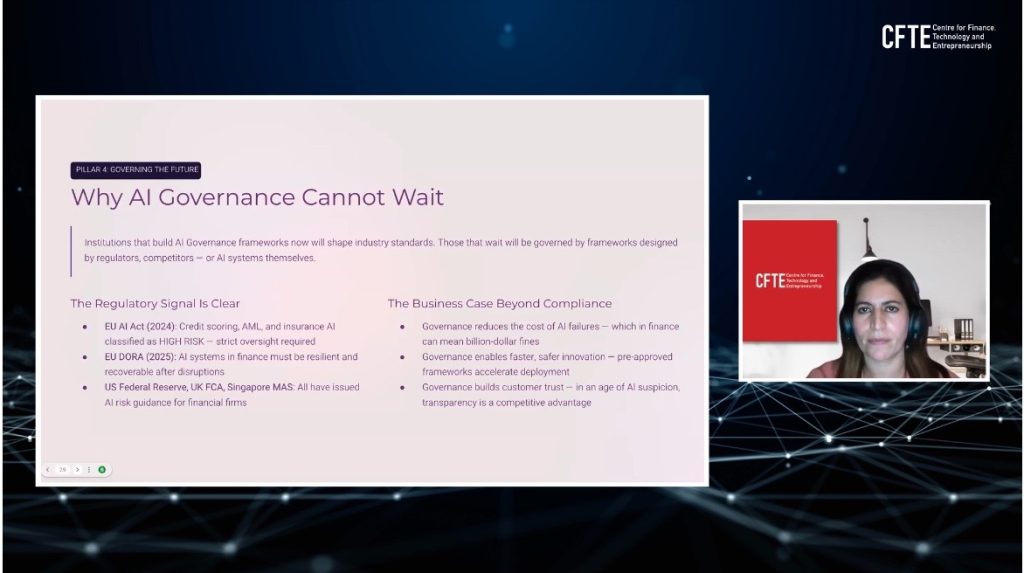
As Dr Amira explained, AI governance is no longer a “nice to have”. It is becoming essential because financial institutions need to know how AI systems are being used, what decisions they influence, what data they rely on, how they are monitored, and who is accountable when something fails.
Finance Is AI’s Native Environment
One of the strongest messages from the webinar was that finance is a natural environment for AI because it is a pure information business.
Every decision in finance can be quantified. Every risk can be measured. Every transaction creates a signal. AI systems are designed to detect patterns, process data at speed and support decision-making at scale.
This is why AI is already transforming multiple areas of financial services.
In algorithmic trading, AI systems can process news, market signals, social media sentiment and price movements in real time. In insurance underwriting, AI can reduce decision-making from weeks to seconds by analysing risk variables, fraud indicators and behavioural patterns. In credit scoring, AI can use alternative data to assess customers who may not have traditional credit histories. In fraud detection, AI can identify suspicious transactions faster than rule-based systems. In wealth management, robo-advisors can make investment guidance more accessible to wider groups of customers.
These use cases show the opportunity. AI can improve speed, efficiency, access and personalisation across financial services.
But they also show why governance is critical.
The Risks Financial Institutions Cannot Ignore
AI in finance brings significant benefits, but it also introduces risks that institutions must manage carefully.
Dr Amira highlighted several governance risks that financial institutions need to address:
Algorithmic bias can occur when AI systems are trained on historical data that already contains discrimination. If past lending or hiring decisions were biased, an AI system may learn and amplify those patterns.
The explainability gap becomes a major issue when AI decisions cannot be clearly explained to customers, regulators, auditors or even internal teams. In financial services, this is especially important because decisions can affect access to credit, insurance, savings and investment opportunities.
Concentration risk can emerge when many financial institutions depend on a small number of AI vendors or models. A vulnerability, update failure or model weakness could become a systemic risk.
Adversarial AI creates new security challenges. Bad actors may attempt to manipulate AI systems, poison data or design fraud patterns that are difficult for automated systems to detect.
Job displacement and workforce disruption also need to be considered, particularly as AI systems become capable of performing increasingly complex tasks across compliance, operations, legal, customer service and analysis.
The lesson is not that financial institutions should avoid AI. The lesson is that they must adopt AI responsibly.
Explainability Is Becoming a Trust Issue
A recurring theme throughout the webinar was explainability.
If an AI system denies a mortgage application, prices insurance differently for two customers or flags a transaction as suspicious, the institution must be able to explain why. Customers need to be able to challenge decisions. Regulators need to audit systems. Internal teams need to understand how models behave.
Dr Amira used real-world examples to show what happens when explainability is weak. In cases where institutions could not explain why a model produced a certain outcome, the issue became more than a technical problem. It became a regulatory, reputational and trust problem.
For financial institutions, explainability is no longer only about model transparency. It is about customer protection, compliance and accountability.
AI Governance Needs to Be Built from the Beginning
One of the clearest messages from the session was that governance must be embedded before AI systems scale.
Institutions cannot wait until after deployment to ask whether a model is fair, explainable or secure. Governance needs to be part of design, procurement, implementation, monitoring and review.
Dr Amira outlined five practical pillars of AI governance:
- Accountability
Organisations need a named AI risk owner or AI governance leader with a real mandate, not just a general department responsible for AI. - Transparency
AI decisions must be logged and explainable, especially when they affect customers. - Fairness
Bias testing should not happen once. Models drift over time, so audits need to be repeated regularly. - Security
AI models should be treated with the same security importance as core banking systems. - Human oversight
Humans must be able to intervene in high-impact decisions, especially in areas such as credit, insurance pricing and anti-money laundering.
A Practical 90-Day Roadmap for AI Governance
For institutions wondering where to begin, Dr Amira shared a practical 90-day roadmap.
In the first 30 days, organisations should conduct a full AI inventory. This means identifying every AI system being used across the institution, including tools embedded in third-party vendor contracts.
In the next 30 days, they should classify AI systems by risk. High-risk areas such as credit scoring, anti-money laundering and insurance pricing require stronger oversight, documentation and explainability.
In the final 30 days, institutions should begin to act. This includes appointing an AI risk owner, drafting an AI policy, implementing explainability logging for high-risk decisions and scheduling regular model audits.
The key message was simple: you cannot govern what you cannot see.
Emerging Markets Need Their Own AI Governance Approaches
Another important insight from the webinar was the need for AI governance frameworks that reflect the realities of emerging markets.
Many global AI governance frameworks have been developed from high-income, Western regulatory contexts. They often assume strong digital identity infrastructure, mature credit bureau systems, advanced supervisory capacity and well-established legal mechanisms.
But many financial institutions and regulators in emerging markets operate in very different environments.
Dr Amira highlighted that this should not be seen only as a challenge. Emerging markets also have an opportunity to develop innovative governance models that reflect local needs, financial inclusion goals, multilingual environments, sparse data contexts and mobile-first financial ecosystems.
This is especially important as AI has the potential to expand access to finance for people who have historically been excluded from traditional banking.
What This Means for Finance Professionals
For CFTE, this webinar reinforced a key point: the future of finance will not only be shaped by technology, but by the people who understand how to use it responsibly.
AI governance is becoming a core capability for financial services professionals. It is relevant not only for data scientists and technology teams, but also for leaders, regulators, compliance professionals, risk teams, product managers, legal teams and customer-facing functions.
As AI becomes embedded across financial services, professionals will need to understand not only what AI can do, but how it should be governed.
Conclusion: The Future of Finance Requires Responsible AI
AI is already changing financial services. The next stage will bring even greater speed, scale and complexity.
The institutions that succeed will not simply be those with the most data or the most advanced models. They will be those with the strongest governance, the clearest accountability and the ability to use AI responsibly.
As Dr Amira reminded participants, the future of AI in finance is not something to fear. It is something to prepare for.
At CFTE, we are committed to helping financial institutions, regulators and professionals build the knowledge and capabilities needed for this next chapter of finance.
