
AI in financial services is not lacking use cases.
It is lacking clarity.
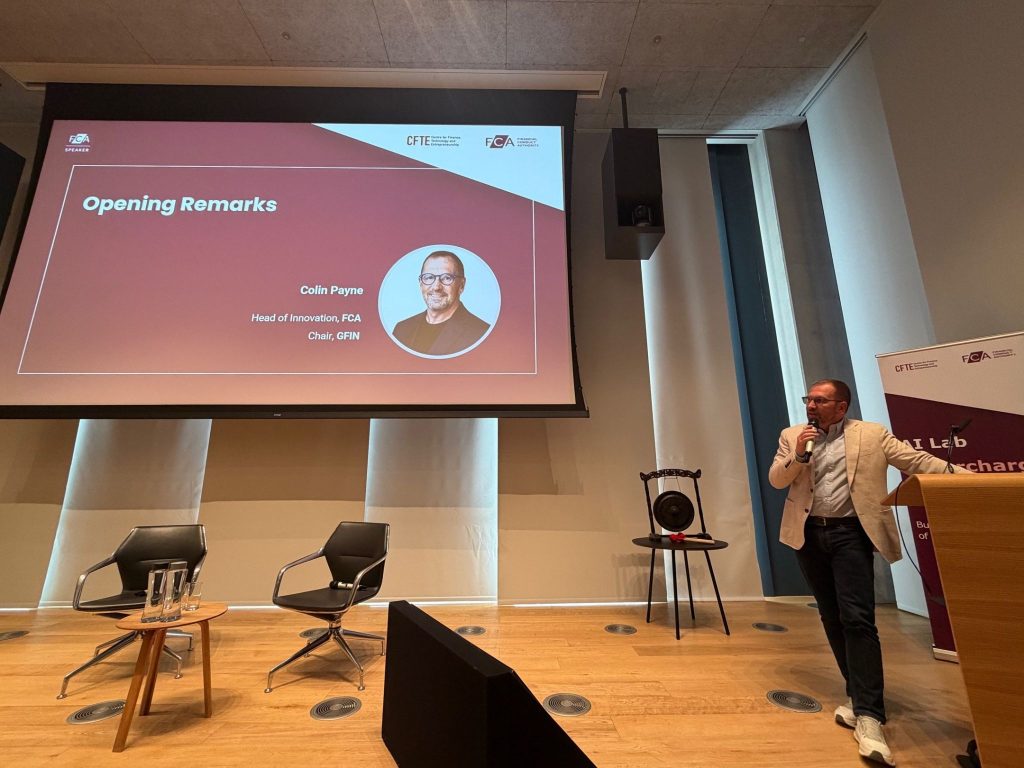
At the Global AI Governance and Innovation Showcase, Colin Payne contributed to an important discussion on how the industry can make sense of AI adoption in practice.
The Meaning of “Using AI”
One challenge stood out clearly:
When organisations say they are using AI, what does that actually mean?
It could mean many different things:
- an idea
- a proof of concept
- a prototype
- a pilot
- an internal tool
- a deployed system
- a production-level solution
Without a common language, it becomes difficult to compare progress across institutions.
It also becomes difficult to understand what is genuinely working.
The Challenge of Comparison
AI adoption is accelerating across financial services.
But without structure, the industry risks confusing activity with progress.
A large number of experiments does not necessarily mean meaningful transformation.
To scale AI effectively, organisations need to understand:
- the maturity of each use case
- whether it is still experimental
- whether it is live in production
- where value is being created
- what risks need to be managed
This requires more than enthusiasm.
It requires classification.
Creating a Common Language
A central theme from the discussion was the need to bring structure to AI adoption.
That means developing a clearer way to:
- define use cases
- distinguish ideas from implementation
- compare maturity
- identify value
- understand what can scale
The goal is not to make AI more complicated.
It is to simplify how the industry understands it.
The Takeaway
As AI adoption grows, the real advantage will not come from experimenting more.
It will come from understanding better.
Colin’s contribution highlighted a critical point for the industry:
To scale AI responsibly, financial services needs clarity, structure, and a common language for what progress really looks like.AI in financial services is not lacking use cases.
It is lacking clarity.
Across the industry, financial institutions are experimenting with artificial intelligence in many different ways. Some are exploring early-stage ideas. Others are developing proofs of concept, testing prototypes, running pilots, building internal tools, or deploying AI into live production environments.
At the Global AI Governance and Innovation Showcase, Colin Payne contributed to an important discussion on how the industry can better understand AI adoption in practice. His contribution highlighted a critical challenge: as AI activity accelerates, financial services needs a clearer way to define what progress actually looks like.
What Does “Using AI” Really Mean?
One of the most important questions facing the industry is also one of the simplest:
When an organisation says it is using AI, what does that actually mean?
The answer is not always clear.
It could mean an idea being explored by a team. It could mean a proof of concept built to test feasibility. It could mean a prototype, a pilot, an internal tool, a deployed system, or a production-level solution already being used in day-to-day operations.
These stages are very different.
An idea is not the same as a pilot. A pilot is not the same as a live system. A live internal tool is not the same as an enterprise-wide production solution.
Without a common language, it becomes difficult to compare progress across institutions. It also becomes difficult to understand which AI initiatives are genuinely creating value, which are still experimental, and which are ready to scale.
The Risk of Confusing Activity with Progress
AI adoption is accelerating across financial services. But more activity does not automatically mean more transformation.
A large number of experiments can create momentum, but it does not necessarily mean that AI is being embedded into business processes, improving outcomes, or delivering measurable value.
This is where clarity becomes essential.
To scale AI effectively, organisations need to understand the maturity of each use case. They need to know whether a use case is still at the concept stage, whether it is being tested in a controlled environment, whether it has been deployed internally, or whether it is operating in production.
They also need to understand where value is being created, what risks need to be managed, and what controls are required before the solution can scale responsibly.
This requires more than enthusiasm.
It requires classification.
From Use Cases to Maturity
A more structured approach to AI adoption would help financial institutions move beyond broad claims about innovation and towards a clearer understanding of implementation.
This means distinguishing between different levels of maturity, such as:
- early ideas
- proofs of concept
- prototypes
- pilots
- internal tools
- deployed systems
- production-level solutions
Each stage carries different implications.
An early-stage idea may need exploration and experimentation. A pilot may need performance testing, user feedback, and risk assessment. A production-level solution requires stronger governance, accountability, monitoring, and controls.
By classifying AI use cases more clearly, institutions can make better decisions about where to invest, what to scale, and what needs further development before wider deployment.
This also helps regulators, industry bodies, and ecosystem partners better understand where the market really stands.
Creating a Common Language for AI Adoption
A central theme from Colin’s contribution was the need to bring more structure to how financial services talks about AI.
The goal is not to make AI more complicated. It is to make AI adoption easier to understand.
A common language would help the industry define use cases more precisely, distinguish ideas from implementation, compare maturity across organisations, identify where value is being created, and understand which solutions are ready to scale.
This matters because AI adoption is no longer only about experimentation. It is increasingly about implementation, governance, and responsible scaling.
Without a shared framework, organisations risk speaking about AI progress in ways that are difficult to compare. With a clearer structure, the industry can have a more practical and transparent conversation about what is actually happening.
Why Clarity Matters
Clarity is essential for responsible AI adoption.
Without it, financial institutions may overestimate the maturity of their AI initiatives or underestimate the controls needed before deployment. They may also find it harder to identify which projects are creating real value and which remain exploratory.
With better classification, institutions can understand where they are on the journey, what they have built, and what needs to happen next.
This creates a stronger foundation for responsible scaling. It allows organisations to move beyond simply generating more use cases and towards understanding which ones are viable, valuable, governed, and ready for real-world use.
The Takeaway
As AI adoption grows across financial services, the real advantage will not come from experimenting more.
It will come from understanding better.
Colin Payne’s contribution highlighted a critical point for the industry: to scale AI responsibly, financial services needs clarity, structure, and a common language for what progress really looks like.
AI adoption is not only about asking who is using AI.
It is about understanding how AI is being used, where it sits in the organisation, and whether it is ready to create value at scale.
