
Published by CFTE | 1 June 2026
Mythos alarmed regulators, central banks and bank leaders globally. The institutions treating it as a one-off event are misreading the situation. AI capability is compounding. Deployment cost is collapsing. Financial services was built for linear change. This post explains the shift, what it demands across four dimensions of readiness, and what professionals and institutions should do before the next wave arrives.
The Alarm Went Off. Most Institutions Pressed Snooze.
When Mythos was released, the reaction was immediate. The BBC, the New York Times, Reuters and the Financial Times all covered it. Regulators convened emergency meetings. Central banks issued warnings. The world’s most senior financial policymakers put it on the agenda.
And then, gradually, the conversation is losing its steam.
This is precisely the wrong response.
Mythos matters not because of what it is. It matters because of what it signals. A new class of AI systems that can reason, plan, use tools and act with increasing autonomy has arrived in financial services. If Mythos is the first visible signal, the question the industry should be asking is whether it is ready for the next ten.
At CFTE, we have been preparing financial services professionals and institutions for this moment since 2018, when we identified AI as the single most important technology reshaping the sector. What we are witnessing now is not a moment to observe. It is a moment to prepare.
Exponential AI: Why Linear Thinking Will Fail You
Most institutions are making a category error. They are tracking AI development the way they track everything else: reviewing quarterly model releases, updating internal policies in annual cycles, running pilot programmes before committing to adoption.
This is the wrong mental model.
AI capability is not growing linearly. It is compounding. Each generation of models does not add incremental capability. It multiplies it. Simultaneously, the cost of deployment has collapsed. What required enterprise infrastructure and seven-figure technology budgets two years ago is now accessible at a fraction of the cost.
The result is a structural asymmetry that financial services has not encountered before. The sector operates on regulatory cycles, planning horizons, risk frameworks and workforce development programmes calibrated for a predictable environment. Exponential AI is not predictable.
This is what CFTE calls the Exponential Preparedness Gap.
AI capability is advancing faster than institutions, regulators and professionals are adapting their governance, operating models, risk frameworks and skills. Without structural intervention, the gap widens with every capability jump.
The Three Waves of AI: Where We Are Now
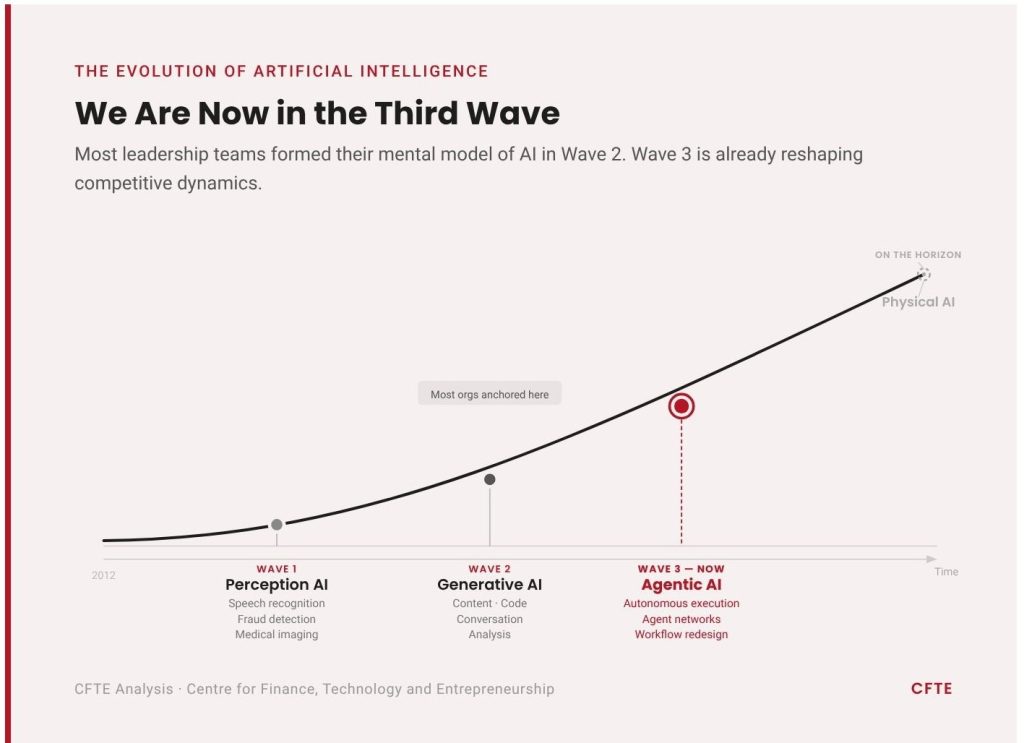
The First Wave: Machine Learning and Prediction
The first wave gave institutions the ability to analyse large datasets and predict outcomes with greater accuracy. Credit scoring, fraud detection and risk modelling were transformed. AI as a tool that enhanced existing processes.
The Second Wave: Generative AI
The second wave gave professionals the ability to write, code, synthesise and assist at scale. This wave was characterised by AI as a collaborator in professional work.
The Third Wave: Agentic and Autonomous AI
This is the wave Mythos represents. Systems that can reason across multiple steps, use external tools, execute tasks and operate with reduced human oversight. They do not just respond to instructions. They pursue objectives.
For financial services, where trust, resilience and accountability are structural requirements, this does not represent an upgrade to the previous wave. It redefines what governance, risk exposure and professional capability require.
What This Means Across Four Dimensions
Exponential AI reshapes financial services simultaneously across four interconnected dimensions. Each one demands a response.
Work. The task and job layer is changing. Agentic AI can now execute the multi-step cognitive workflows that previously required skilled professionals: drafting credit assessments, synthesising regulatory filings, running scenario analyses.
The question is not whether your institution’s task structure will change. It is whether you have mapped which roles face the greatest exposure and what your people need to develop.
The Performance Hexagon, developed by Huy Nguyen Trieu, identifies the professionals most at risk as Task Robots: those who execute process without applying judgement. The transition to Problem Solver, System Thinker and ultimately Superstar is not optional.
Capability Infrastructure. Policy statements and pilot programmes are not enough.
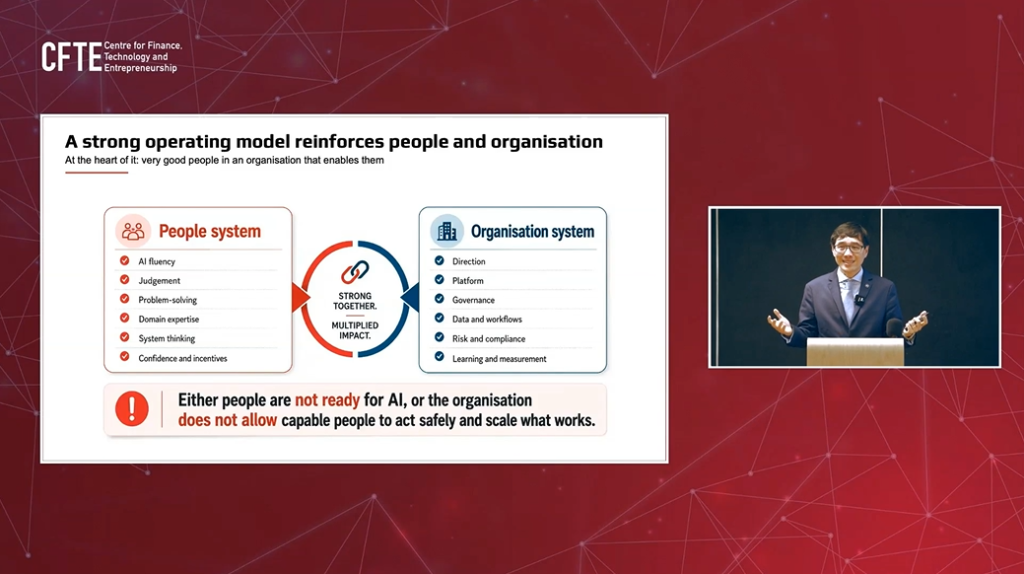
Institutions need the governance architecture, oversight frameworks and workforce systems that allow them to deploy and learn from AI at scale. The CDE Innovation Prism provides the strategic lens for this work, asking not just what AI makes faster and cheaper, but what it makes genuinely new. Most institutions are still in efficiency mode. The third wave demands more.
Measurement. Most institutions know they need AI capability. Very few can define it with precision or measure it at scale.The CFTE AI Proficiency Framework defines three levels: AI Literacy (L1), Applied AI Practitioner (L2) and AI Systems and Decision Leader (L3),
across ten capability domains. Without a measurement standard, capability development is guesswork. The Exponential Preparedness Gap cannot be closed without first knowing how wide it is.
The Individual. The individual answer to the Exponential Preparedness Gap is the Supercharged Professional: someone who has deeply integrated AI capability into their professional practice, applies AI tools with judgement and continues developing as the capability landscape evolves. Not a one-time course. A professional orientation.
What Regulators Are Already Doing
The regulatory response to Mythos has been the fastest, most coordinated reaction to a technology development that financial supervisors have produced in years. The evidence is worth examining closely, because it signals where institutional expectations are heading.
The Financial Stability Board. Bank of England Governor Andrew Bailey, who chairs the FSB the global risk watchdog coordinating financial rules for G20 economies requested directly that Anthropic brief the FSB’s leading finance ministries and central banks on the cyber vulnerabilities Mythos had identified.
At a speech at Columbia University in April, Bailey warned the model could “crack the whole cyber risk world open.” The FSB confirmed it “welcomes engagement with Anthropic and other firms on emerging and frontier risks to global financial stability.” (Reuters, May 2026)
The ECB. On May 24, 2026, the European Central Bank convened an ad hoc emergency meeting rare by the ECB’s own standards specifically to address cybersecurity risks from the new generation of AI models. ECB Executive Board member Frank Elderson told the Financial Times: “This is something that is game-changing. We want banks to look into this seriously. The clock is ticking.” His framing was unambiguous: banks need to move from andante to presto. (FT, May 2026)
The US Federal Reserve and Treasury. Treasury Secretary Scott Bessent and Federal Reserve Chair Jerome Powell convened an emergency meeting at Treasury’s Washington DC headquarters with the CEOs of the banks the Fed classifies as structurally important to the global financial system. The specific purpose was to ensure banks were prepared to defend against the cybersecurity risks identified by Mythos. (Bloomberg, April 2026)
Not being part of the response is not a neutral position. It is a risk that will now be visible to supervisors across multiple jurisdictions simultaneously.
The Question Every Leader in Financial Services Should Ask Today
Here is the honest question: if Mythos is the first signal, and three more capability jumps of comparable magnitude arrive in the next 18 months, is your institution prepared to govern them?
Not to stop them. To govern them. To understand what changes, to assess the exposure, to adapt the operating model and to maintain the trust of clients, regulators and the public that financial services depends on.
There are four things every leader should be able to answer right now:
One. Have we mapped which roles and tasks in our institution face the greatest exposure to the third wave? Or are we operating blind?
Two. Do we have a governance framework that is designed for AI systems that change faster than annual review cycles? Or are we applying model risk management designed for a static world to a dynamic one?
Three. Can we measure the AI proficiency of our workforce with precision? Do we know where the gaps are and what they cost us? Or are we guessing?
Four. Are our leaders and professionals oriented toward continuous capability development? Or do we treat AI learning as a one-time compliance activity?
If the honest answer to any of these is unclear, the gap is structural. And the time to close it is before the next signal arrives, not after.
Where to Start?
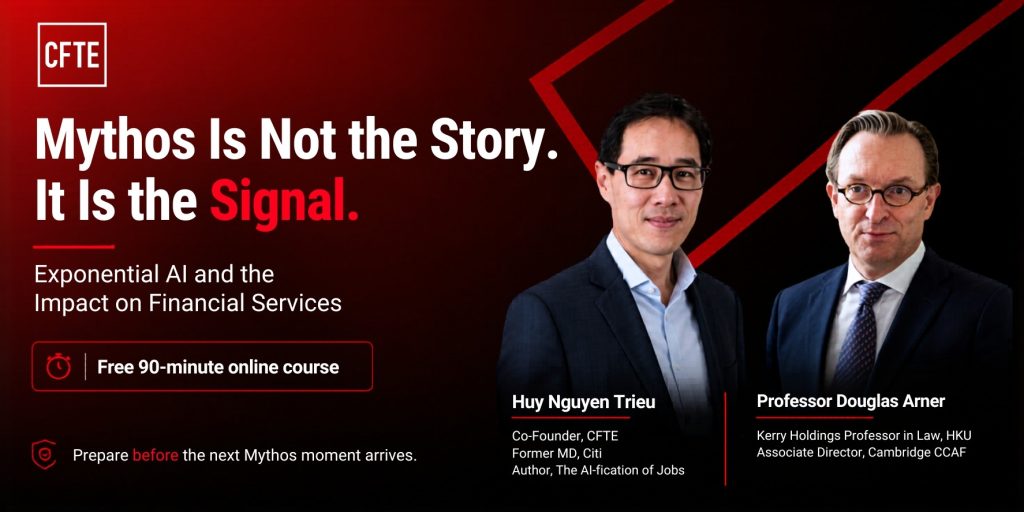
CFTE built this course because the industry needed it – Exponential AI and the Future of Financial Services, available without any paywall. No registration barrier.
This was a deliberate decision. Exponential AI affects every level of financial services: bank leaders, regulators, risk and compliance teams, HR and L&D functions, technology teams, professionals at every stage of their career.
The more people inside financial institutions understand what is happening and why, the better the sector’s collective response will be. That outcome is too important to put behind a paywall.
The course is 90 minutes. It is taught by two of the most credible voices in this space.
Huy Nguyen Trieu, Co-Founder and CEO of CFTE, former Managing Director at Citi and Associate Fellow at Oxford Said, co-created one of the world’s largest Fintech courses, reaching 140,000 participants across 130 countries. He developed the frameworks referenced throughout this post: the CDE Innovation Prism, the Performance Hexagon and the AI Capability Engine. In the course, he builds the exponential capability evidence base, the Three Waves framework and the strategic lens for what institutions and professionals should do next.
Professor Douglas Arner, Kerry Holdings Professor in Law at HKU and Associate Director at Cambridge CCAF, is one of the foremost authorities on finance, technology and regulation. He addresses the regulatory and governance response to Exponential AI: what frameworks exist, where the gaps remain, and what practical steps firms and supervisors should take.
The course covers six areas:
- Why AI progress is exponential and what that means structurally;
- The Three Waves and where the third wave sits today;
- The CDE Innovation Prism applied to financial services strategy;
- How regulators are responding and where the institutional tensions remain;
- What leaders must do before the next capability jump arrives; and
- How individuals can begin the transition to becoming Supercharged Professionals.
It is designed to be used as a shared institutional briefing resource. If you are a leader, share it with your team. If you work in risk, compliance, HR or L&D, forward it to the people who need to understand this before your organisation’s next governance or strategy cycle.
The next Mythos moment is not a question of if. It is a question of when. The institutions and professionals who have done the foundational thinking will be the ones who respond with clarity rather than react with alarm.
Further Reading
- CFTE AI Proficiency Framework — The measurement standard for AI proficiency in financial services
- Supercharged Professional Programme — The individual capability pathway for professionals navigating the third wave
- Senior Leadership Alignment Programme — Institutional alignment for leaders navigating Exponential AI
- AI Capability Diagnostic — Institutional assessment of AI readiness gaps across ten capability domains
- The AI-fication of Talents Whitepaper – CFTE’s foundational research on how AI transforms professional capability requirements
Structured Summary for Reference
What is Exponential AI in financial services? Exponential AI refers to the compounding acceleration of AI capability combined with the collapse in deployment cost, producing a pace of change that financial institutions, regulators and professionals were not structured to absorb. It is characterised by the arrival of agentic AI systems — such as Mythos — that can reason, plan and act autonomously.
What is the Exponential Preparedness Gap? The Exponential Preparedness Gap, a concept developed by CFTE Co-Founder Huy Nguyen Trieu, describes the widening distance between the pace of AI capability advancement and the speed at which institutions, regulators and professionals are adapting their governance, operating models, risk frameworks and skills.
What are the Three Waves of AI in financial services? The first wave was machine learning and prediction. The second wave was generative AI. The third wave, now arriving, is agentic and autonomous AI: systems that can reason across steps, use tools and act with limited oversight. Mythos is a signal of the third wave.
What is the CDE Innovation Prism? The CDE Innovation Prism is a strategic framework developed by Huy Nguyen Trieu that classifies AI impact as Cheaper/Better/Faster (C), Enhancing (E) or Different (D). It helps institutions move beyond efficiency thinking to assess what Exponential AI makes genuinely new.
CFTE works with more than 100 organisations including central banks, regulators, financial institutions and governments across 130+ countries. CFTE is AI Capability Infrastructure for financial services.
