
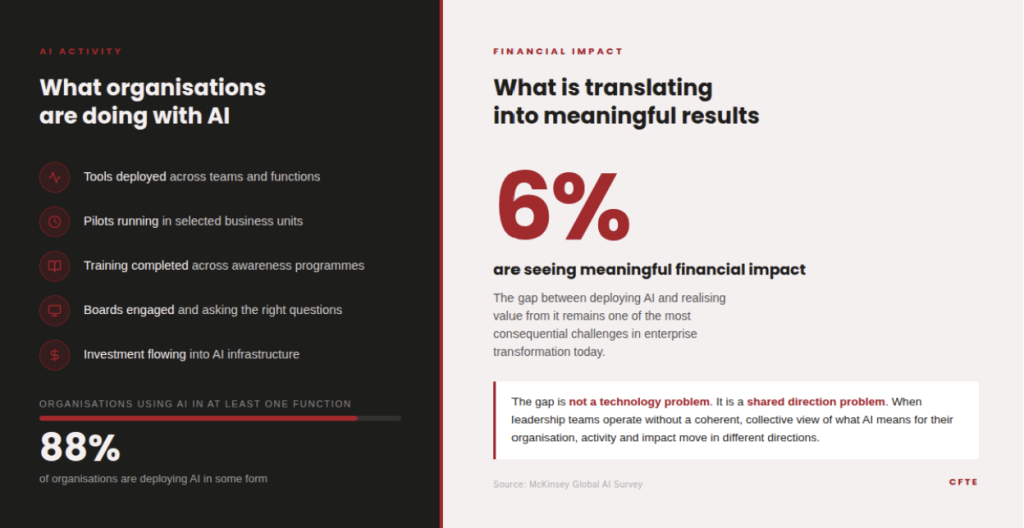
88% of organisations are now using AI in at least one business function. Only 6% are seeing meaningful financial impact. That gap is real, and it is instructive. It does not reflect a problem with the technology. It reflects something more structural: what happens when AI activity moves faster than the shared leadership direction needed to guide it.
A New Landscape for Leadership Teams
AI has moved from a specialised technical topic to a core strategic question for every organisation. Tools are being deployed. Pilots are running. Boards are asking sharper questions. Investment is flowing. For leadership teams across financial services, this is an exciting and genuinely complex moment to navigate.
The complexity is not primarily technical. Most senior leaders do not need to understand how a large language model is trained. What they do need is a shared and coherent view of what AI means for their organisation: its strategy, operating model, governance obligations, risk appetite, value creation priorities, and talent implications.
That is a different kind of challenge from understanding the technology itself. And it is the challenge that most organisations are still working through.
Why This Matters: The Alignment Gap and What It Produces
When leadership teams operate with fragmented rather than shared understanding, several things tend to follow. Knowledge levels across the executive team are unequal, making it difficult to have a productive strategic conversation. Different functions pursue AI opportunities in parallel without a coherent view of priorities. Governance responsibilities become unclear. And the organisation accumulates AI activity without building the system-level direction that turns activity into transformation.
None of this is a failure of leadership. It is the natural result of trying to navigate a genuinely unprecedented shift at pace, without the structured tools and environments designed to help leadership teams think through the implications together.
Research consistently shows that high-performing organisations are three times more likely to have senior leaders who demonstrate genuine ownership of and commitment to AI initiatives, not just budget approval. That level of ownership does not emerge from exposure to information alone. It emerges from leaders working through the strategic implications in a structured way, together.
The Cost of Not Aligning
Most conversations about AI failure focus on the wrong variable. They point to poor data quality, the wrong vendor, or technology that was not ready. The research points elsewhere.
80% of AI projects fail to deliver business value
95% of GenAI pilots never reach production
When you examine what these projects have in common, the pattern holds across industries and institution types. It is rarely a technology problem.
Failure breaks down into three distinct modes.
Projects abandoned before they ever reach production.
Projects completed but generating no measurable business value.
Projects that produce some output but cannot justify what was spent to build them.
Three different failure modes. One common thread: leadership that was present at launch but absent during execution.
The adoption numbers make this more striking.
78% of organisations are actively integrating AI into their operations
23% of leaders feel confident their workforce can use it effectively
In financial services specifically, the stakes are higher than in any other sector.
82.1% AI project failure rate in financial services. The highest of any industry.
$7.2M average sunk cost per abandoned AI initiative
42% of companies abandoned at least one AI initiative in the past year
This is not a technology risk. It is a strategic and governance risk.
The organisations that consistently land in the successful 20% are not working with better technology. They define what success looks like before a single line of code is written. They keep leadership actively engaged beyond the announcement and the launch. And they treat capability as something to be built and measured, not assumed.
That last point is where most organisations carry the largest blind spot. You cannot direct what you cannot see. Most leadership teams do not have a clear, evidence-based view of where their people actually stand on AI readiness. And without that view, AI investment remains a bet rather than a decision.
The core barrier to AI transformation is not knowledge. It is alignment. And the cost of not addressing it is not theoretical. It is measurable, recurring, and in financial services, higher than anywhere else.
What Alignment Actually Requires
Moving from fragmented AI awareness to shared strategic direction requires four things that are distinct from what individual training programmes are designed to produce.
A shared foundation of understanding across the team. Not every executive needs the same depth of AI knowledge. But every executive needs enough common ground to participate meaningfully in strategic discussion. Without that foundation, the conversation defaults to whoever is most informed in the room.
Strategic framing rather than technical framing. Senior leaders need to understand what AI means for strategy, operating model, governance, risk exposure, and talent priorities. These are different questions from those that technical or awareness training is built to answer.
Structured discussion oriented toward decisions. A leadership team that leaves a session with higher awareness but no shared conclusions has not moved forward in the way the organisation needs. Effective alignment requires facilitated conversation that surfaces real differences in perspective, works through them, and produces shared positions on priorities and ownership.
An environment designed for honest, senior-level dialogue. Senior leaders engage most productively in environments that are genuinely impartial, free from vendor agendas, and designed to be safe for uncertainty and honest prioritisation.
The Compounding Value of Getting This Right
Nearly two thirds of organisations have not yet begun scaling AI across the enterprise. The organisations that make the strongest transitions will not necessarily be those that deployed AI fastest. They will be the ones whose leadership teams built genuine shared direction early, before the pressure to act became overwhelming.
The question for any leadership team is not whether they have been exposed to AI. The question is whether they have sat in the same room, with the right framing, and decided together what it means for this organisation, at this stage, in this competitive environment.
That conversation has compounding value. And the structural investment required to create the right conditions for it is modest relative to what it enables.
How CFTE Supports Leadership Teams on This Journey
CFTE’s Senior Leadership Alignment Programme is designed precisely for this moment. It is not a technical training session. It is not a vendor demonstration or a consulting pitch. It is a structured, expert-led decision environment that helps senior leadership teams interpret the business implications of AI together, across strategy, operating model, value creation, governance, risk, and talent priorities.
The programme is delivered by practitioners with direct experience in financial services and institutional transformation. It is impartial by design. And it is built around the four conditions above: a shared foundation, strategic framing, structured discussion, and an environment that senior leaders can engage in honestly.
Organisations that have moved from fragmented awareness to genuine leadership alignment on AI have done so not because the technology became simpler, but because they created the right conditions for the leadership conversation. That is what we are here to support.
About CFTE
The Centre for Finance, Technology and Entrepreneurship (CFTE) is a global platform that builds capabilities in finance and technology. Headquartered in London, with offices in Singapore and Abu Dhabi, CFTE works with governments, regulators, and financial institutions to design frameworks, programmes, and learning systems that support transformation at scale. CFTE’s programmes have reached learners in more than 130 countries.
Media and partnership enquiries: partners@cfte.education
