
AI capability is one thing.
Applying it responsibly in a regulated environment is another.
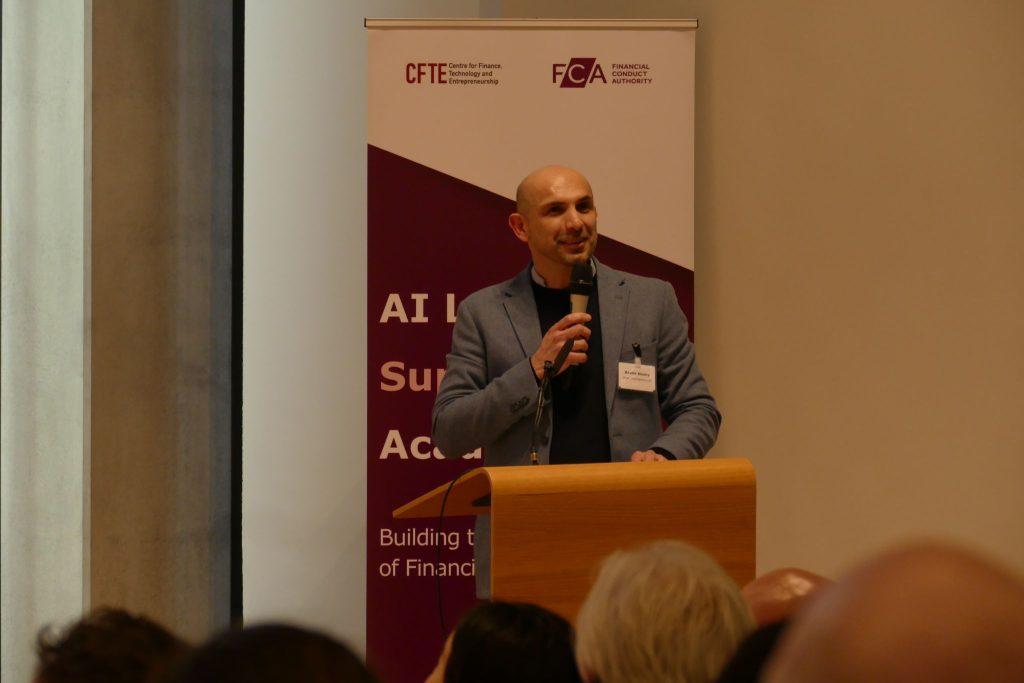
At the Global AI Governance and Innovation Showcase, Bashir Khairy shared his transformation journey through the FCA AI Lab Supercharged Academy, highlighting what it takes to move from understanding AI in theory to applying it in practice.
His experience reflected a central message for the financial services industry: the next phase of AI will not be defined by ambition alone. It will be defined by responsible execution.
Innovation and Governance Cannot Be Separated
A key theme from Bashir’s journey was clear: AI innovation and governance cannot be treated as separate priorities.
In financial services, AI solutions must be designed with responsibility in mind from the beginning. This means thinking not only about what the technology can do, but also about how it will operate within regulated systems, how risks will be managed, and how trust will be maintained.
Responsible AI in finance requires attention to:
- risk
- accountability
- transparency
- regulatory expectations
- customer impact
- operational resilience
These are not secondary considerations. They are essential to whether an AI solution can move from experimentation to real-world use.
AI is therefore not only a technical challenge. It is also an organisational, regulatory, and governance challenge.
Learning by Building
Through the FCA AI Lab Supercharged Academy, participants did not only explore AI concepts in theory. They worked on applying those concepts to real financial services challenges.
This included building use cases, shaping AI propositions, testing ideas against market and regulatory needs, and understanding how solutions fit within complex financial systems.
This kind of applied learning is critical.
The real transformation does not happen when professionals simply understand what AI can do. It happens when they understand how to apply it responsibly, in a way that creates value while addressing the expectations of customers, institutions, and regulators.
For Bashir, the Academy journey represented this shift: from learning about AI to building with AI, and from exploring possibilities to understanding what responsible implementation requires.
Moving from Experimentation to Implementation
Financial services is now moving into a new phase of AI adoption.
The industry is no longer focused only on experimentation. Increasingly, the challenge is how to implement AI solutions safely, responsibly, and at scale.
That creates new demands for practitioners.
They need to be able to identify meaningful use cases, explain the value of their solutions, anticipate risks, understand governance requirements, and build trust with stakeholders.
This requires a combination of technical understanding, business relevance, regulatory awareness, and practical execution capability.
Bashir’s journey reflects this broader industry shift. It shows that AI adoption in financial services is not just about having ideas. It is about developing solutions that can operate in the real world.
Governance as Part of Execution
One of the most important lessons from Bashir’s experience is that governance should not be seen as something that comes after innovation.
It needs to be built into the process from the start.
For AI solutions in financial services, this means considering how the system will be monitored, who will be accountable, how decisions will be reviewed, and how risks will be identified and managed.
When governance is integrated early, it becomes an enabler of responsible innovation. It gives institutions and stakeholders greater confidence that AI solutions can be tested, deployed, and scaled safely.
Without governance, AI may remain experimental.
With the right governance, AI can move towards meaningful implementation.
The Takeaway
The next phase of AI in finance will not be defined by excitement alone.
It will be defined by execution.
Bashir Khairy’s experience through the FCA AI Lab Supercharged Academy shows that responsible AI requires more than ambition. It requires the ability to connect innovation with governance, theory with practice, and ideas with systems that can work in real-world regulated environments.
In financial services, responsible AI is not only about what can be built.
It is about what can be trusted.
