
AI adoption in financial services is not only about understanding what the technology can do.
It is about learning how to work with it responsibly.
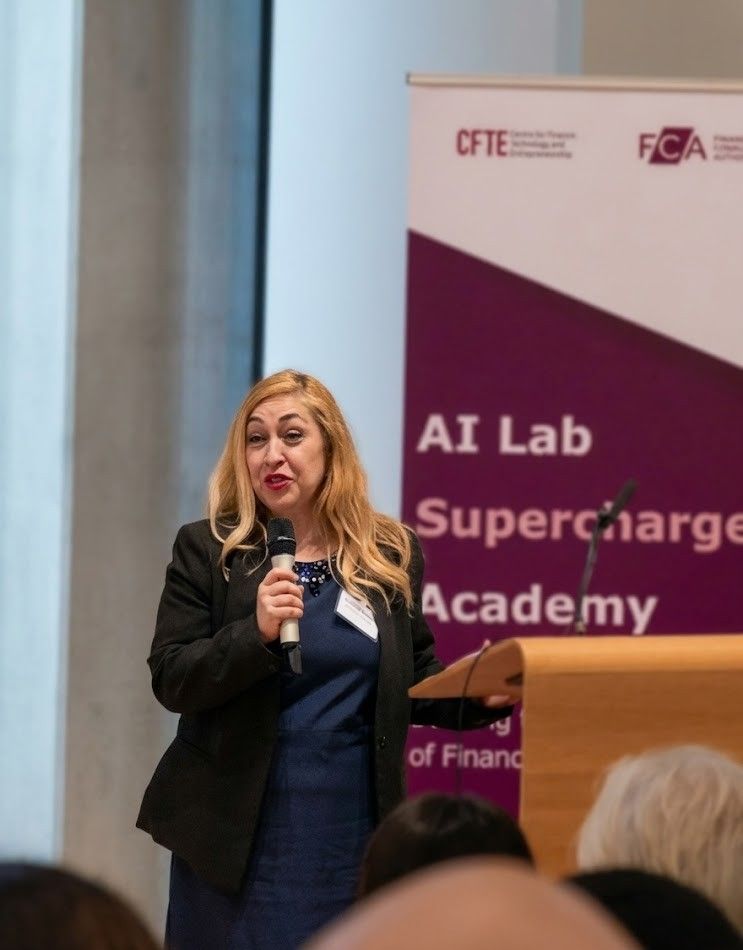
At the Global AI Governance and Innovation Showcase, Denisse Rudich, who leads Compliance and Governance at Sherloc, shared a powerful reflection on what it means to engage with AI in today’s financial services environment.
Denisse was named Valedictorian of the Financial Conduct Authority AI Lab Supercharged Academy — a recognition of her commitment throughout the programme and her leadership in responsible AI.
Her journey captured one of the most important lessons from the Academy: responsible AI starts with learning, reflection, and the confidence to engage with new tools in a meaningful way.
A Transformative Experience
The FCA AI Lab Supercharged Academy was not only about understanding AI capability.
It was about understanding how AI should be used.
Participants explored some of the most important issues facing financial services today, including bias, hallucinations, governance, accountability, systemic risk, and responsible adoption.
These topics are central to the future of AI in finance. As institutions move from experimentation to implementation, professionals need to understand not only the opportunities created by AI, but also the risks, limitations, and responsibilities that come with its use.
For Denisse, the experience was both personal and professional.
As she shared:
“I have worked with the FCA Innovation team for nearly 10 years, so being named Valedictorian was a pretty big deal for me. The AI Lab Supercharged Academy required a lot of hard work, but it was transformative. It has changed the way I think about and interact with AI. Now, I have robot helpers, and it no longer feels as scary.”
Her reflection speaks to a wider shift taking place across the industry. AI is no longer something professionals can observe from a distance. It is becoming part of how work is done, how decisions are supported, and how organisations think about innovation and risk.
From Fear to Confidence
One of the most important shifts Denisse described was a change in mindset.
AI moved from something uncertain or intimidating to something that could be understood, managed, and applied responsibly.
This shift matters.
For many professionals, especially those working in compliance, governance, risk, and regulation, AI can initially feel complex or difficult to control. The technology is evolving quickly, and its implications are not always straightforward.
But responsible AI adoption depends on professionals developing the confidence to engage with it.
That does not mean accepting AI without question. It means understanding how it works, where it can add value, where it may create risks, and what safeguards are needed.
Confidence in AI does not come from ignoring its limitations.
It comes from learning how to work with those limitations responsibly.
Why Governance Matters
In financial services, AI cannot be treated as a standalone innovation.
It must be connected to risk management, compliance, accountability, customer outcomes, and organisational responsibility.
This is why Denisse’s perspective is so important. Her background in compliance and governance reflects the kind of expertise that will be essential as financial institutions adopt AI more widely.
AI systems need more than technical performance. They need oversight, controls, transparency, and clear accountability. They need to be designed and deployed in ways that align with institutional responsibilities and regulatory expectations.
In this context, governance is not a barrier to innovation.
It is what allows AI to be used safely, confidently, and responsibly.
Responsible AI Starts With People
Denisse’s recognition as Valedictorian highlights a broader shift in the industry.
AI adoption is not just about tools, systems, or models. It is also about people.
Financial services needs professionals who can understand AI, question it, apply it, and govern it. It needs people who can bridge innovation with responsibility and ensure that new technologies are used in ways that create value while protecting trust.
The Academy helped participants build that capability. It gave them the structure to explore AI in depth, the space to reflect on its risks and opportunities, and the confidence to apply what they learned in their own professional contexts.
This kind of capability-building is essential for the next phase of AI adoption.
The Takeaway
The future of AI in finance will not be shaped by technology alone.
It will be shaped by professionals who understand both its opportunities and its risks.
Denisse Rudich’s journey through the FCA AI Lab Supercharged Academy shows that responsible AI starts with learning, reflection, and the confidence to engage with new tools in a thoughtful way.
AI may become more powerful, more accessible, and more embedded in financial services.
But trust will depend on the people who know how to use it responsibly.
